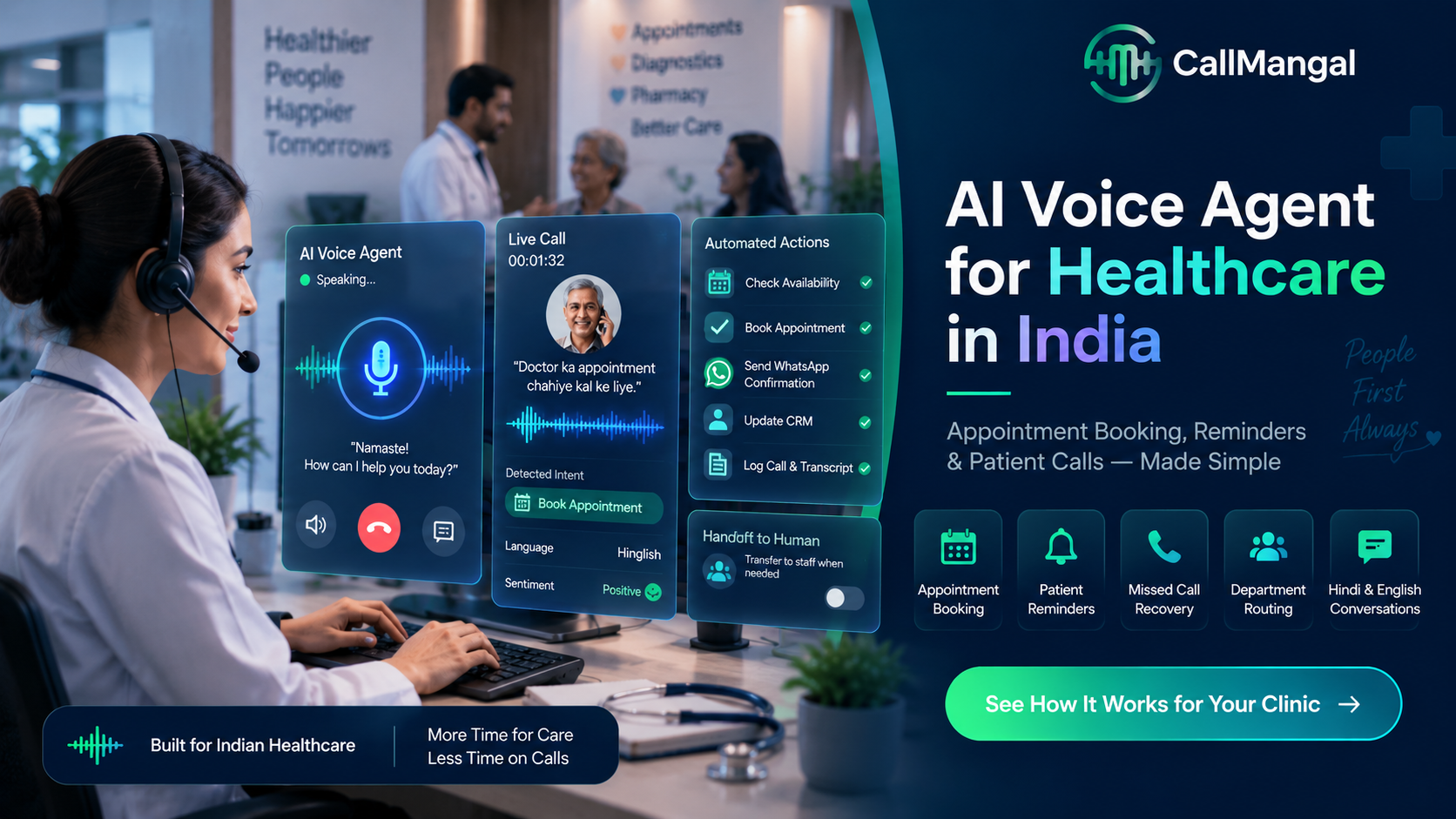
Indian clinics and hospitals lose a lot of time on routine phone calls, appointment booking, rescheduling, reminders, missed calls, directions, doctor availability, report follow-ups, and department routing.
These calls are important, but they do not always need a doctor or senior staff member. During busy OPD hours, front desk teams are already handling walk-ins, billing questions, patient files, and internal coordination. After hours, many calls simply go unanswered.
An AI voice agent for healthcare helps manage these routine calling workflows. It can answer calls, understand the patient's request, collect basic details, book or reschedule appointments, send reminders, route calls, and transfer sensitive conversations to a human team member.
It does not replace doctors, nurses, or medical judgment. It works best as a support layer for structured patient communication, while clinical, urgent, or sensitive conversations stay with trained staff.
What Is an AI Voice Agent for Healthcare?
An AI voice agent for healthcare is a phone-based assistant that can speak with patients and complete predefined call workflows.
It can help with:
- Appointment enquiries
- Appointment booking
- Rescheduling requests
- Patient reminders
- Missed-call recovery
- Basic clinic FAQs
- Department routing
- Human handoff
For example, if a patient calls to book a consultation, the voice agent can ask for basic details, understand the appointment type, confirm the next step, and trigger a follow-up action through WhatsApp, calendar, CRM, or another connected system.
Why Clinics and Hospitals Need Voice AI
Most healthcare calls are operational, not clinical.
Patients usually ask things like:
- Can I book an appointment?
- Is the doctor available today?
- Can I reschedule my visit?
- What are the clinic timings?
- Where is the clinic located?
- What documents should I bring?
- Can I get a confirmation on WhatsApp?
- Can someone call me back?
These questions may look simple, but they affect patient experience, appointment attendance, and front-desk workload.
A healthcare AI voice agent can handle these routine calls consistently and transfer the conversation when the patient needs human help.
Healthcare Use Cases for AI Voice Agents
Appointment Booking
The voice agent can collect the patient's name, phone number, preferred doctor, department, appointment type, and preferred time slot.
It can then follow the clinic's booking rules and confirm the next step.
Best for:
- New patient appointments
- Follow-up visits
- Doctor availability enquiries
- Department-based appointments
- Diagnostic or consultation scheduling
Rescheduling and Cancellations
Patients often call to change or cancel appointments. The voice agent can capture the request, confirm key details, and update the workflow when your system allows it.
If the case needs approval or manual review, the call can be transferred or flagged for staff.
Patient Reminders
The voice agent can make or support reminder calls for:
- Upcoming consultations
- Follow-up visits
- Report pickup
- Required documents
- Post-consultation instructions
- Missed appointment follow-ups
This helps reduce manual calling work for the front desk.
Missed-Call Recovery
Many clinics miss calls during peak hours. A voice agent can answer when staff are busy, capture the caller's intent, and help the team follow up with the right context.
This is useful during:
- Morning OPD rush
- Evening appointment hours
- Lunch breaks
- After-hours enquiries
- Campaign or seasonal traffic
Basic Patient FAQs
A lot of calls are about simple information.
The voice agent can answer approved questions about:
- Clinic timings
- Location
- Consultation process
- Documents to bring
- Doctor availability
- Follow-up process
- Callback requests
For anything outside approved information, the call should go to staff.
Department Routing
In hospitals and multi-specialty clinics, patients may not know whom to speak with.
The voice agent can identify the reason for the call and route it to reception, billing, diagnostics, pharmacy, support, or a human representative.
Example Healthcare Call Workflow
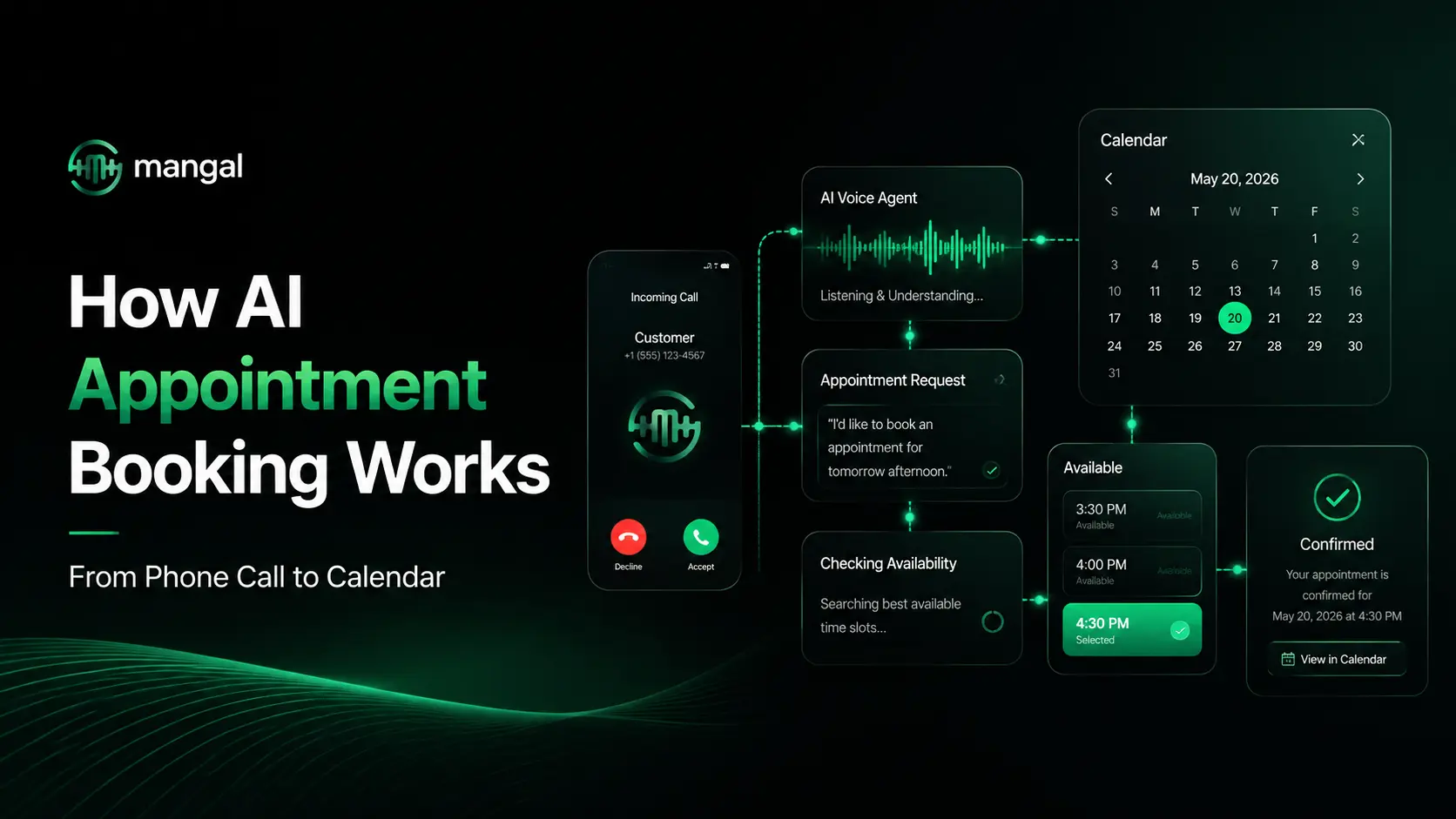
Here is how an appointment booking workflow can work:
A patient calls the clinic.
The voice agent greets the patient in Hindi, English, or Hinglish.
It asks the reason for the call.
The patient says they want to book an appointment.
The voice agent asks for basic details such as name, phone number, appointment type, doctor, department, or preferred date.
It checks the configured booking workflow.
It confirms the appointment request or next step.
It sends a WhatsApp confirmation if configured.
It updates the calendar, CRM, or clinic system if connected.
It stores the call outcome, recording, or transcript for staff review.
If the patient asks something urgent, clinical, emotional, or complex, the call is transferred to a human team member.
This type of workflow keeps routine conversations organized without removing human support from sensitive cases.
Why Healthcare Voice AI Needs an India-First Approach
Healthcare calling in India is not always clean, scripted, or fully in English.
Patients may speak in Hindi, English, Hinglish, or a mix of local language patterns. Some patients explain things in short phrases. Some interrupt. Some call from noisy places. Elderly patients may prefer speaking instead of using apps or forms.
A healthcare voice agent for India should be tested on real patient-style calls, not only perfect demo conversations.
It should be able to:
- Understand Hindi-English mixed conversations
- Handle common patient phrases
- Ask for clarification when needed
- Repeat important details
- Support appointment and reminder workflows
- Trigger WhatsApp or CRM actions
- Transfer complex calls to staff
See our guide on multilingual AI voice agents in India.
What an AI Voice Agent Should Not Do in Healthcare
Healthcare needs clear boundaries.
An AI voice agent should not:
- Give a diagnosis
- Replace doctor judgment
- Suggest treatment
- Handle emergencies alone
- Collect unnecessary sensitive health information
- Invent medical answers
- Continue when confidence is low
The safer model is simple:
AI handles structured routine workflows.
Humans handle clinical, urgent, emotional, sensitive, or exception-heavy conversations.
This keeps the voice agent useful without letting it move into areas that need medical staff.
Good Fit vs Not Good Fit
Good Fit for AI Voice Agents
- Appointment booking
- Appointment reminders
- Rescheduling requests
- Basic clinic FAQs
- Department routing
- Missed-call recovery
- Follow-up calls
- WhatsApp confirmations
- Call recordings and transcripts
Not a Good Fit Without Human Handoff
- Diagnosis
- Emergency handling
- Medical advice
- Complex clinical questions
- Sensitive patient complaints
- Treatment recommendations
- High-risk conversations
This distinction is important. A healthcare voice agent should improve routine communication, not take over medical decision-making.
Best First Workflow to Automate
The best first workflow is usually appointment booking or missed-call recovery.
These workflows are:
- Easy to define
- High in call volume
- Low risk compared to clinical conversations
- Easy to measure
- Useful for both staff and patients
For most clinics, appointment booking is the simplest starting point. The rules are clear: collect details, confirm intent, check availability or process, send confirmation, and hand off when needed.
For busy clinics, missed-call recovery can be equally valuable because it helps capture enquiries that would otherwise be lost.
Once the first workflow is working well, you can expand to reminders, follow-ups, department routing, and other routine call types.
Before You Automate: What to Prepare
Before setting up a healthcare AI voice agent, prepare the information it should use.
You will need:
- Clinic timings
- Doctor or department list
- Appointment rules
- Consultation types
- Location and directions
- Approved FAQ answers
- WhatsApp confirmation format
- Calendar or CRM access
- Emergency handoff rule
- Billing or report-related escalation rules
- Staff contact for transferred calls
This preparation matters. The quality of the voice agent depends on the clarity of your workflow and the information it is allowed to use.
Integrations That Make Healthcare Voice AI More Useful
A healthcare voice agent becomes more useful when it connects with the systems your clinic or hospital already uses.
Useful integrations may include:
- Appointment calendar
- CRM or patient management system
- WhatsApp follow-up
- Call recordings
- Call transcripts
- Internal dashboard
- Webhooks
- REST API
- Human handoff rules
For example, after a call, the voice agent can save caller details, send appointment information to a calendar, trigger a WhatsApp confirmation, update a CRM, or store the transcript for staff review.
This helps avoid scattered information and gives the team a clearer view of each patient call.
How to Start a Healthcare AI Voice Pilot
You do not need to automate every healthcare call on day one. Start with one workflow and test it properly.
Step 1: Choose One Workflow
Start with appointment booking, reminders, or missed-call recovery.
Step 2: Prepare Approved Clinic Information
Add clinic timings, location, departments, doctors, appointment rules, escalation instructions, and approved answers.
Step 3: Define Human Handoff Rules
Decide when the call should go to staff. This may include emergencies, clinical questions, billing disputes, angry callers, low-confidence answers, or special requests.
Step 4: Test Hindi, English, and Hinglish Calls
Test real patient-style calls. Include short replies, interruptions, accents, background noise, and mixed-language phrases.
Step 5: Review Recordings and Transcripts
Check whether the voice agent understood the caller, collected the right details, and followed the expected workflow.
Step 6: Improve the Script
Update prompts, questions, handoff rules, confirmation messages, and follow-up actions based on test calls.
Step 7: Expand Gradually
Once the first workflow is reliable, expand to reminders, follow-ups, department routing, and other routine calls.
Common Mistakes to Avoid
Automating Too Many Workflows at Once
Start small. A single well-tested workflow is better than five half-ready workflows.
Not Defining Human Handoff
Every healthcare workflow needs clear escalation rules. If the patient asks something clinical, urgent, emotional, or unclear, the call should move to staff.
Using Generic Scripts
Healthcare calls need approved clinic-specific information. Generic answers can create confusion.
Ignoring Hindi and Hinglish Testing
Many Indian patients will not speak in polished English. Test the voice agent on the way patients actually talk.
Not Reviewing Transcripts
Recordings and transcripts help you improve the script, catch errors, and understand common caller issues.
Treating Voice AI as a Doctor Replacement
That is the wrong use case. The voice agent should support routine communication, not replace clinical judgment.
Metrics Healthcare Teams Should Track
Track simple, practical numbers.
Important metrics include:
- Calls answered
- Missed calls recovered
- Appointments booked
- Appointments rescheduled
- Reminder confirmations
- Human handoff rate
- Failed conversations
- Repeat calls
- Transcript quality
- WhatsApp confirmation completion
- Staff time spent on routine calls
Do not judge the system only by call volume. The real value is whether calls are handled correctly, patients get the right next step, and staff spend less time on repetitive communication.
Where CallMangal Fits
CallMangal can be configured for Indian healthcare teams that want to manage routine patient calls more efficiently.
For clinics and hospitals, it can support workflows such as appointment enquiries, appointment booking, reminders, follow-ups, department routing, recordings, transcripts, CRM or WhatsApp actions, and human handoff.
This means routine calls can be handled more consistently, while sensitive, urgent, or complex conversations remain available for staff review.
Want to Test This for Your Clinic?
Bring one real workflow, appointment booking, missed-call recovery, or patient reminders.
CallMangal can help you test how a healthcare voice agent answers the call, collects details, completes the next action, and transfers the conversation when human support is needed.
FAQs
Can an AI voice agent book appointments for clinics?
Yes. It can collect basic patient details, understand the appointment request, follow your booking workflow, confirm the next step, and trigger follow-up actions when configured.
Can it handle Hindi and Hinglish patient calls?
Yes, when it is configured and tested for Hindi, English, and mixed-language conversations. This is important for Indian clinics where patients often switch between languages.
Can it send appointment confirmations on WhatsApp?
Yes. If WhatsApp is connected, the voice agent can send appointment confirmations, reminders, follow-up messages, or next-step instructions after the call.
Can it reschedule or cancel appointments?
Yes, if your workflow and connected systems allow it. The voice agent can collect the request, confirm details, and update or flag the appointment for staff review.
Can it transfer emergency or sensitive calls to humans?
Yes. Human handoff should be part of every healthcare workflow. Clinical, urgent, emotional, sensitive, angry, or low-confidence calls should move to trained staff.
Can it integrate with clinic calendars or CRM?
Yes. Depending on your systems and API access, it can connect with calendars, CRMs, patient systems, WhatsApp, dashboards, or custom workflows.
Is AI voice safe for healthcare calls?
It can support routine healthcare communication when boundaries are clear, approved scripts are used, and human handoff rules are in place. It should not diagnose, give medical advice, or handle emergencies alone.
How should clinics start with an AI voice agent?
Start with one workflow, such as appointment booking or missed-call recovery. Test real calls, review transcripts, define handoff rules, and expand only after the first workflow is reliable.
.webp)