.webp)
Here is a sentence that can expose the weakness of a voice AI system very quickly:
“Bhaiya, mera order kab tak aayega, like it's been 3 days already.”
That is not broken Hindi or broken English.
It is a normal example of how many Indian customers speak on the phone: switching languages naturally, keeping familiar English terms, using local pronunciation, and changing tone without consciously choosing one language or the other.
A voice agent that performs well only in clean English or only after the caller selects “Hindi” from a menu can struggle with this kind of conversation.
This matters to businesses in India as well as US companies serving customers in India, running sales or support operations there, or building products for Indian-language audiences.
For this market, multilingual voice AI is not simply about how many languages appear on a vendor's feature page.
The more useful question is:
Can the agent understand how your customers actually speak and still complete the task they called about?
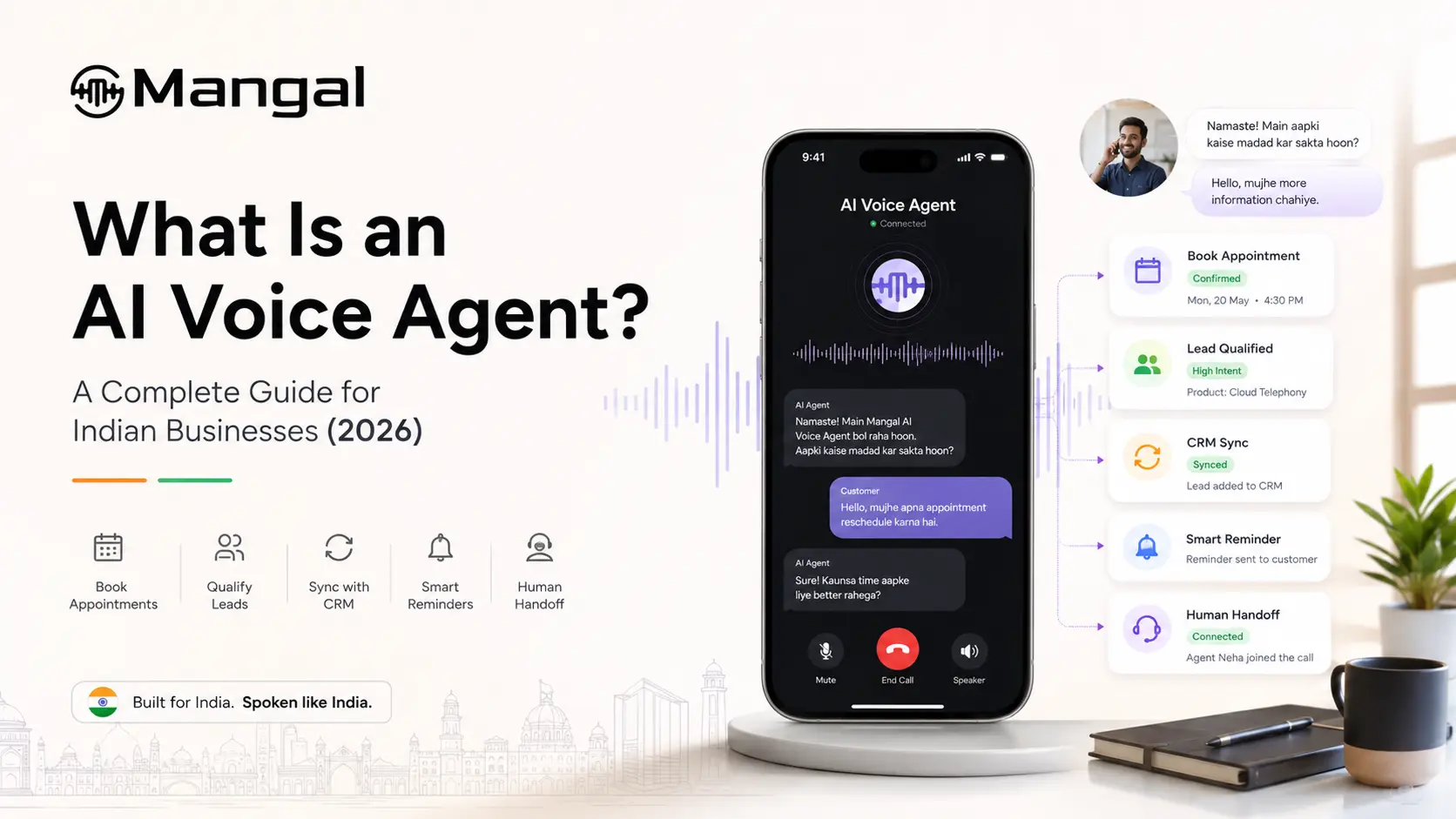
If you are still defining the basics, start with our guide to what an AI voice agent is.
Quick takeaway
A strong multilingual AI voice agent for Indian customers should be able to:
- Handle code-switching, not just separate Hindi and English calls.
- Understand accents, numbers, industry terms, interruptions, and real phone conditions.
- Complete the customer's task, not simply produce an accurate transcript.
That final point matters. A 2026 research preprint evaluating a Hindi voice agent used 3,760 multi-turn tests across 960 simulated calls and found that performance on individual components did not reliably predict successful end-to-end task completion.
Why “multilingual” means something different in India
In a basic multilingual system, a caller might select one language and remain in that language for the entire call. For example:
“Press 1 for English. Press 2 for Hindi.”
That can be useful, but it does not reflect many everyday conversations in India.
A customer might begin in English:
“I'm calling about my last payment.”
Then switch:
“Actually payment deduct ho gaya tha but account mein show nahi ho raha.”
Then continue with:
“EMI status check kar do.”
This is code-switching or code-mixing. India-focused speech technology increasingly supports these patterns directly. Sarvam's current Saaras v3 model supports 23 languages — 22 Indian languages plus English — and includes a code-mixed mode for mixed-language speech.
Multilingual support is not the same as code-switching
| Capability | What it means | Example |
|---|---|---|
| Multilingual support | The system supports multiple languages | Full call in Hindi |
| Language selection | The caller chooses a language | “Press 2 for Hindi” |
| Language detection | The system identifies the spoken language | Caller begins speaking Hindi |
| Code-switching | The system follows language changes within a sentence or conversation | “Mera order cancel karo because it's too late” |
| Regional adaptation | The system handles accents, pronunciation, and local vocabulary | Different regional styles of spoken Hindi |
A vendor saying “we support 20+ languages” tells you about coverage. It does not tell you how well the system handles Hindi, Hinglish, numbers, interruptions, or your industry's vocabulary on an actual customer call.
How a multilingual AI voice agent actually works
Think of a voice AI conversation as five connected steps.
1. The caller speaks
The input may contain:
- Hindi
- English
- Hinglish
- A regional language
- Names
- Numbers
- Industry terminology
- Background noise
- Interruptions
Real customer calls rarely sound like polished demo scripts.
2. Speech recognition processes the audio
Speech-to-text, often called STT or ASR, converts spoken audio into text or another machine-readable representation. For an Indian customer call, it may need to understand phrases such as:
“COD available hai kya?”
“Mera phone number hai 9840...”
“Appointment kal afternoon mein shift kar do.”
India-focused speech infrastructure increasingly accounts for this kind of input. Sarvam documents code-mixed speech support and identifies 8 kHz phone audio as a common production scenario for Indian voice applications.
3. The agent understands intent and context
Correct transcription is only part of the job. The system also needs to determine: what does the customer actually want?
For example:
“Order abhi tak nahi aaya, cancel kar do.”
The task is not simply “understand Hindi.” The actual workflow may be:
Identify the order → understand the cancellation request → check the relevant business rules → take the correct next action.
4. The agent performs the business action
Depending on the use case, the agent may need to:
- Check an order
- Book an appointment
- Update a CRM
- Confirm a payment
- Qualify a lead
- Schedule a callback
- Update delivery information
- Trigger another workflow
This is what separates a useful voice agent from a system that only holds a conversation.
5. The agent generates a spoken reply
The final response also needs to sound natural. That includes:
- Pronunciation
- Rhythm
- Pauses
- Tone
- Vocabulary
- Level of formality
A technically correct response can still feel unnatural if it uses words or phrasing customers would rarely use themselves.
Language accuracy is not the same as conversational naturalness
Indian customers commonly keep familiar English words inside Hindi or regional-language conversations. For example:
- EMI
- COD
- GST
- Order ID
- Appointment
- Delivery
- Refund
- Payment
- Pin code
Automatically translating every familiar English term into formal Hindi can make a conversation sound less natural, not more natural.
Conversational register matters too. If a caller uses respectful “aap,” the agent should avoid suddenly switching into an inappropriate or overly casual style.
Strong multilingual voice AI therefore needs more than vocabulary. It needs to preserve the way people actually communicate.
Why multilingual voice AI matters to the business
Customer trust
Customers should not have to simplify their normal speech just to communicate with automation. If someone speaks naturally and repeatedly hears “Sorry, could you say that again?” confidence can disappear quickly.
Resolution rate
If language problems repeatedly push calls to human agents, the business gets less value from automation. The better question is not only “did the system hear the sentence correctly?” It is “did the customer complete the task successfully?”
Customer reach
English-only automation can unnecessarily narrow the audience for businesses serving customers across India. The right language strategy should follow actual customer geography, language preferences, and call patterns, not simply the maximum number of languages listed on a product page.
Why US companies serving India need multilingual voice AI
A company's headquarters do not determine the language its customers use. A US-based company may still need Hindi, Hinglish, or regional-language voice support when it:
- Sells products or services in India
- Supports customers in the Indian market
- Runs lead-generation or sales campaigns in India
- Operates customer-success workflows for Indian users
- Manages cross-border support or service operations
- Uses voice automation across multiple markets
For US teams, weak language handling can show up as higher escalation rates, lower automation coverage, and an inconsistent customer experience across markets.
The voice agent should therefore be evaluated in the environment it will actually serve. A polished English-language demo recorded under ideal conditions does not prove that the same system will perform well with a Hinglish-speaking customer on an everyday mobile call in India.
Where multilingual AI voice agents can be useful
| Industry | Example voice tasks |
|---|---|
| Ecommerce | Order status, COD confirmation, cancellations, refunds |
| BFSI & Lending | EMI reminders, payment status, lead qualification |
| Healthcare | Appointment booking and reminders |
| Logistics | Delivery coordination and address confirmation |
| Recruitment | Candidate screening and interview scheduling |
| Local Services | Lead qualification, booking and follow-up |
| Real Estate | Lead qualification and visit scheduling |
| SaaS & Technology | Customer onboarding, support triage and follow-up |
These are already practical production use cases. ElevenLabs reports that Meesho uses a real-time voice agent for Hindi and English customer support and that the bot handles more than 60,000 customer calls per day, including queries about order delays, cancellations, and refunds.
Why multilingual voice AI matters more in 2026
Multilingual voice AI is no longer limited to small experimental demos.
In May 2026, Salesforce launched Hindi support for Agentforce Voice and said the system was engineered to understand natural Hindi-Hinglish code-switching. Salesforce also positions the capability around enterprise data and business workflows rather than speech transcription alone.
India-focused speech infrastructure is expanding as well. Saaras v3 currently supports 23 languages: 22 Indian languages plus English, along with code-mixed speech and telephony-oriented use cases.
Production examples are also easier to evaluate. ElevenLabs reports Meesho's Hindi-English voice agent handling more than 60,000 customer calls each day.
None of this means multilingual voice AI has become perfect. It means businesses now have better tools and more real-world evidence to evaluate before deploying.
How to choose a multilingual AI voice agent in India: 7 tests
Do not accept “Yes, we support Hindi.” as the complete answer. Test the system yourself.
1. Test mid-sentence code-switching
Switch naturally between Hindi and English without warning. Do not prepare an “AI-friendly” sentence. Speak the way your customers normally speak.
2. Test different speakers and accents
Ask several people to make test calls using their normal speaking style. One polished demo voice does not represent your customer base. If a US team is evaluating an India deployment, include people who actually speak with the accents and language patterns its target customers use.
3. Test real industry vocabulary
Use the words your customers actually say.
- For ecommerce: COD, refund, order ID, delivery date
- For lending: EMI, due date, principal, foreclosure
- For healthcare: doctor names, medicine names, appointment slots
- For SaaS: subscription, plan, login, account, upgrade, ticket
Generic conversation accuracy does not automatically guarantee accuracy on business-specific vocabulary.
4. Test numbers and critical identifiers
Test phone numbers, prices, dates, order IDs, account references, and pin codes. A small mistake in casual conversation may not matter. A small mistake in an amount, date, or order number can change the outcome completely.
5. Interrupt the agent
Real callers do not always wait until the AI finishes speaking. This type of interruption is often called barge-in in voice systems. Interrupt the agent midway, then check whether it stops naturally, understands the interruption, preserves context, responds to the new request, and continues from the correct point.
6. Test on the phone network your customers will use
Do not evaluate the full system only from a laptop on clean office Wi-Fi. If your target users are in India, test realistic phone conditions: mobile networks, background noise, speakerphone, different devices, and weaker connections.
Sarvam's current India-focused documentation highlights 8 kHz phone audio as a common condition that Indian-language products may need to handle, and its speech-to-text API supports 8 kHz telephony input.
7. Measure task completion
Finally ask: did the agent actually finish the job? A natural conversation that fails to update the booking, retrieve the correct order, or record the correct payment status is still a failed call.
Want to pressure-test this yourself? Run the same seven tests on a live voice agent. Do not limit the demo to easy questions. Mix Hindi and English, interrupt the agent, use numbers and IDs, and ask it to complete an actual workflow. You can use the same framework when testing a live CallMangal conversation.
5 Hinglish tests you can use in a voice AI demo
Your own customer conversations are the best test data. These examples are useful starting points.
Code-switch test
“Bhaiya, mera order cancel karna hai because delivery bahut late ho gayi hai.”
Payment test
“Meri EMI ₹8,450 hai na? Next due date confirm kar do.”
Appointment test
“Kal morning wala appointment afternoon mein shift ho sakta hai?”
Identifier test
“Order ID A-F-28471 ka current status batao.”
Language-switch test
Start in English:
“I need help with my refund.”
Then continue:
“Payment toh deduct ho gaya tha, refund kab tak aayega?”
Whenever possible: you should control the test, not the vendor.
Don't judge voice AI on transcription accuracy alone
Word Error Rate and transcription accuracy are useful engineering metrics. They are not the complete customer outcome.
| Metric | What it tells you |
|---|---|
| Transcription accuracy / WER | Were the spoken words recognized correctly? |
| Critical entity accuracy | Were dates, amounts, and IDs captured correctly? |
| Intent accuracy | Did the system understand what the caller wanted? |
| Task completion rate | Did the agent successfully finish the workflow? |
| Handoff rate | How often was human intervention needed? |
| Interruption recovery | Did the system recover after the caller interrupted? |
| Response latency | Did the conversation remain comfortable? |
This distinction is more than theoretical. The 2026 FormBharo research preprint evaluated a Hindi voice agent using 3,760 multi-turn tests across 960 simulated calls. The researchers found that individual component performance did not reliably predict end-to-end form completion, while errors in real-speech transcripts could materially reduce task success.
For teams evaluating voice AI, the lesson is straightforward: benchmark the complete customer journey, not only the speech model.
5 red flags when a vendor claims “multilingual support”
1. You can only hear a pre-recorded demo
A real multilingual agent should be able to handle unscripted input. Ask to speak to it yourself.
2. Every conversation requires a fixed language selection
Language menus can still be useful. But “press 2 for Hindi” should not be presented as proof of natural Hindi-English code-switching.
3. The vendor talks only about language count
“20+ languages” is a coverage claim. Ask instead: how well does Hindi perform? How well does Hinglish perform? Can the agent switch languages mid-sentence? How does it handle our terminology? How does it perform through our target phone network?
4. Nobody can explain how language quality is tested
Ask whether testing includes code-switching, different speakers, numbers, domain vocabulary, barge-in, real phone calls, and task completion.
5. There is no clear failure or human-handoff strategy
No voice AI system will understand every caller perfectly. What matters is how the system responds when it does not.
Which Indian languages should your business support?
Do not begin with “how many languages can we launch?” Begin with “which languages do our customers already use?”
Prioritize languages based on:
- Existing call-language mix
- Customer geography
- Call volume
- Failed or escalated calls by language
- Revenue importance of each customer segment
- Quality available for the required use case
A business serving mostly Delhi and North India may get significant value from Hindi, English, and Hinglish first. A healthcare provider concentrated in Tamil Nadu may need Tamil much earlier. A pan-India operation may need a phased rollout.
Language strategy should follow the target customer base, not feature-count competition.
Regional languages need the same quality testing
Supporting Tamil, Telugu, Bengali, Marathi, Gujarati, or another regional language should not simply mean adding one more option to a language menu. Apply the same quality tests used for Hindi and Hinglish:
- Test with native speakers
- Include regional accents and natural speaking styles
- Mix in commonly used English terms
- Test names, amounts, dates, and identifiers
- Use real industry vocabulary
- Check tone and level of formality
- Measure whether the workflow is completed successfully
Current Indian-language speech systems demonstrate that broad language coverage is technically possible, but coverage alone does not tell you whether a specific workflow will perform well for your customers. Saaras v3, for example, currently supports 22 Indian languages plus English.
What should happen when the AI doesn't understand?
Good multilingual voice design does not assume the agent will never fail. It defines a safe recovery path. The agent should be able to:
- Ask the caller to repeat or clarify
- Confirm critical numbers and amounts
- Avoid inventing missing information
- Adapt language when useful
- Escalate after repeated misunderstandings
- Transfer to a human when the workflow requires it
- Preserve relevant context during handoff
For important workflows: a clear fallback is safer than a confident guess.
Multilingual voice AI for inbound vs outbound calls
Language quality matters in both directions.
An inbound AI voice agent needs to understand the language the customer naturally begins using. An outbound AI voice agent may need to adapt reminders, qualification questions, appointment calls, collections conversations, or follow-ups to the recipient's preferred language.
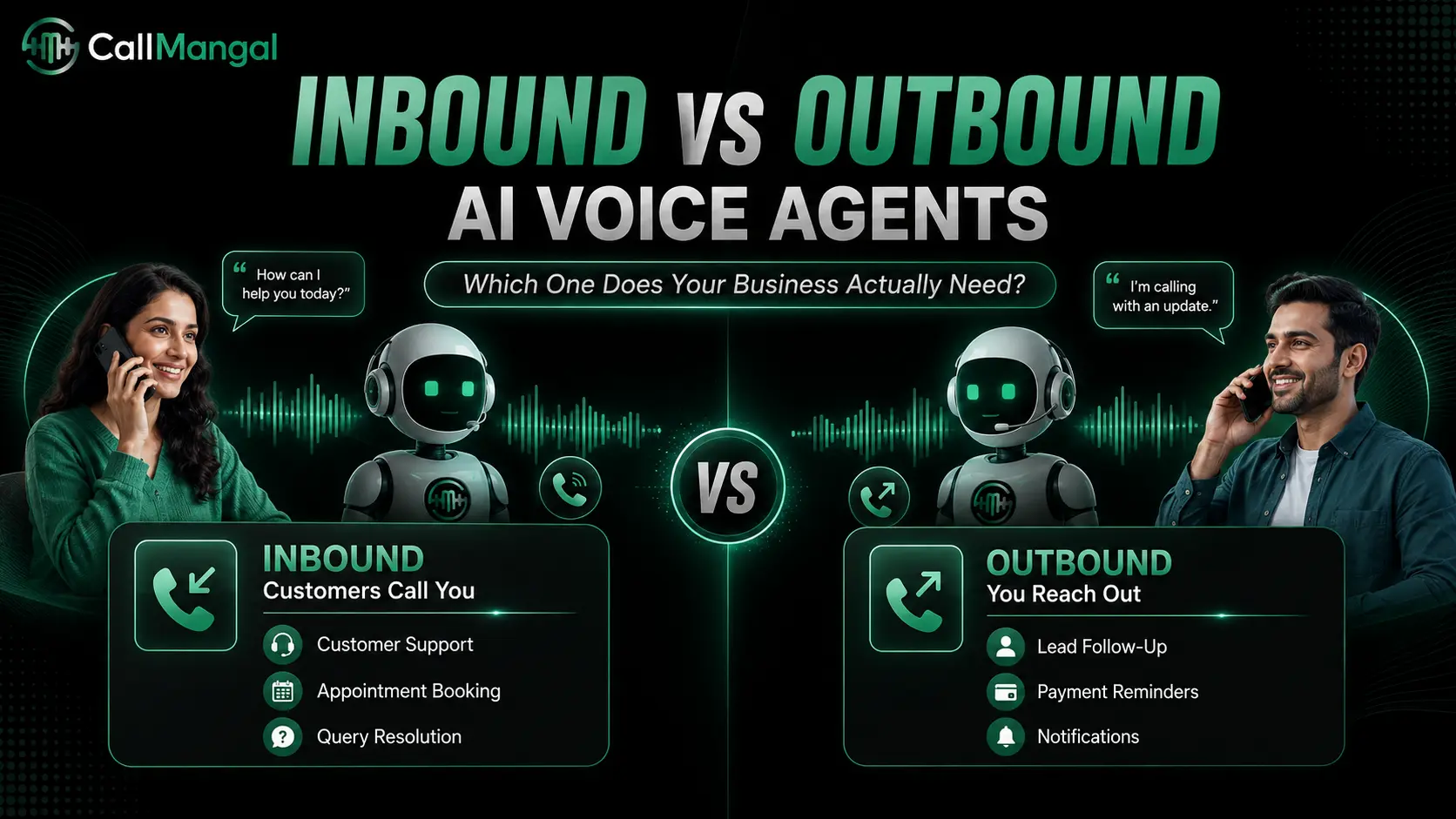
The underlying language technology may overlap, but the business workflows are different. For a deeper comparison, read Inbound vs Outbound AI Voice Agents and explore the AI Voice Agent Use Cases library.
Frequently asked questions
What is a multilingual AI voice agent?
A multilingual AI voice agent can understand and respond to callers in more than one language. For customers in India, useful multilingual support may also require code-switching, regional accents, familiar English terms inside Indian-language speech, reliable handling of numbers, and natural spoken responses.
What is Hinglish code-switching?
Hinglish code-switching happens when a speaker naturally moves between Hindi and English within the same conversation or sentence. For example:
“Mera refund abhi tak nahi aaya, can you check the status?”
The system needs to preserve the meaning even though the language changes.
Can an AI voice agent switch between Hindi and English automatically?
Systems designed for code-mixed speech can handle Hindi-English language changes without forcing every sentence into one language. Current Indian-language speech systems such as Saaras v3 explicitly support code-mixed speech.
Which Indian languages should my voice agent support?
It depends on your customers. Hindi and English may be a practical starting point for some businesses, while Tamil, Telugu, Bengali, Marathi, Gujarati, or other regional languages may matter more for others. Use customer geography, call volume, and actual language patterns to determine the rollout order.
Do US companies need Hindi or Hinglish voice agents?
They may if they serve customers in India or manage significant Indian-language calling workflows. The decision should be based on the language spoken by the target customer population rather than the location of the company's headquarters.
Does multilingual voice AI increase latency?
Perceived latency depends on the complete voice stack, including speech recognition, reasoning, business integrations, speech generation, and telephony infrastructure. Instead of relying only on a vendor's headline latency number, test a complete call using the type of connection your customers will actually use.
How should I test a Hindi or Hinglish AI voice agent?
Use realistic conversations. Mix Hindi and English, include business terminology, include numbers and IDs, interrupt the agent, use different speakers, test via a real phone connection, and verify that the final business task was completed correctly.
When should an AI voice agent transfer to a human?
Human handoff makes sense when the agent repeatedly cannot understand the caller, reaches an exception outside its workflow, lacks permission to act, or encounters a situation that requires human judgment. The handoff should preserve useful conversation context whenever possible so the customer does not have to restart.
Don't take “Hindi & Hinglish support” on trust. Test it.
A feature list cannot tell you whether a multilingual AI voice agent will work for your customers. The simplest test is to speak the way they speak.
Switch between Hindi and English. Use a real order ID. Say the industry terms your customers use. Interrupt the agent. Ask it to complete an actual workflow.
Whether your team is based in India, the United States, or operates across both markets, evaluate the agent against the people who will actually be calling.
CallMangal is designed around multilingual voice workflows, including natural Hindi-English conversations and code-switching use cases.
Explore the CallMangal platform, then try a live CallMangal call and evaluate it using the same tests in this guide.
If you want to test CallMangal against your own workflow, book a demo.