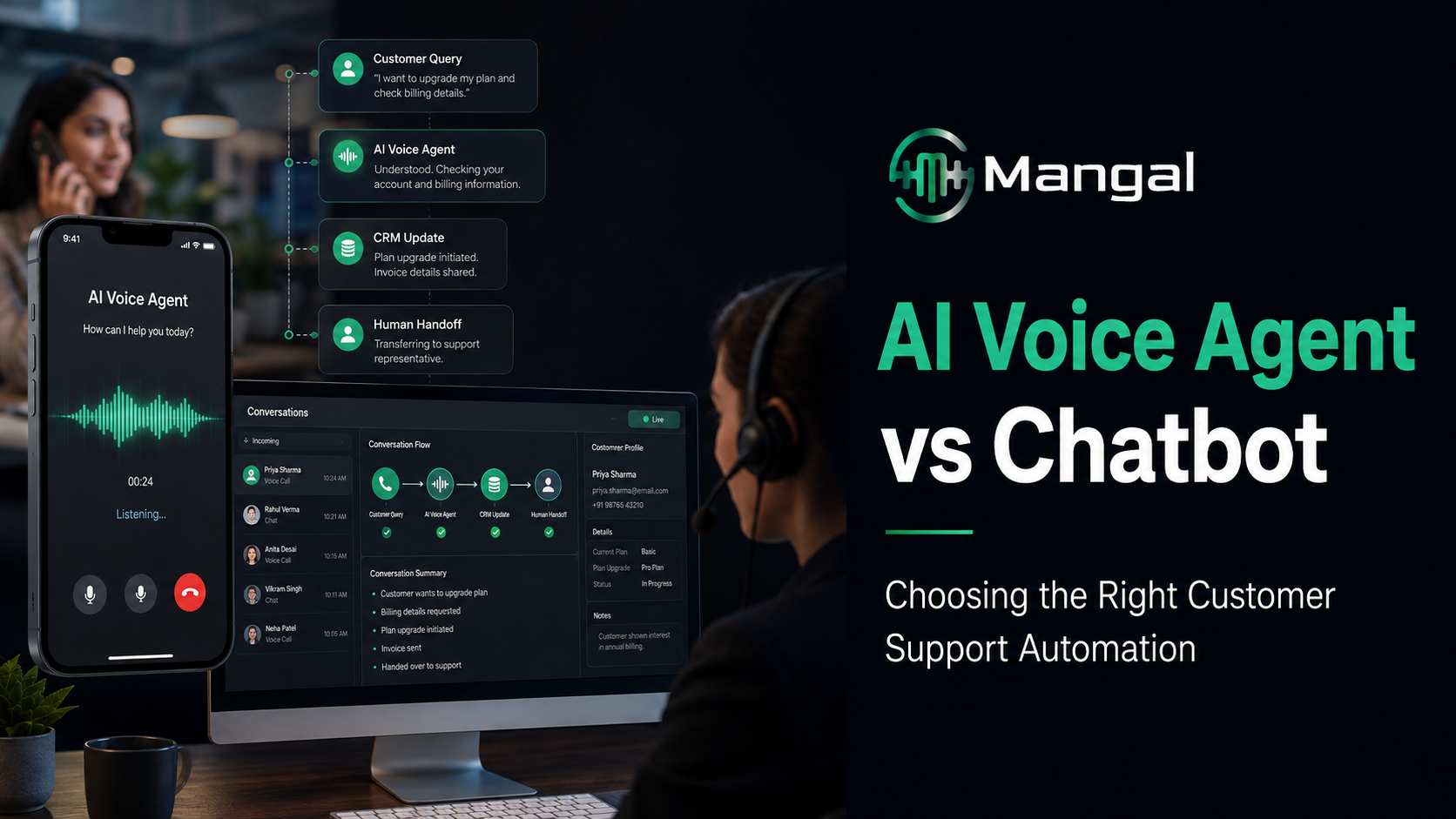
Businesses today have more customer conversations than ever before.
Customers ask questions through websites, messaging apps, phone calls, and multiple digital channels. Managing these conversations manually can become difficult as customer volume grows.
This is why businesses are adopting AI-powered customer support solutions.
Two common options are:
- AI chatbots
- AI voice agents
But choosing between them is not about selecting the newest technology.
The better question is:
Does your customer need an answer, or do they need a conversation that leads to an action?
An AI chatbot is usually better for text-based information and self-service.
An AI voice agent is better when customers need real-time conversations, qualification, scheduling, follow-ups, or support through phone calls.
AI Voice Agent vs Chatbot: Quick Comparison
| Factor | AI Chatbot | AI Voice Agent |
|---|---|---|
| Main channel | Website, WhatsApp, messaging | Phone calls |
| Customer interaction | Text | Voice conversation |
| Best for | Information and self-service | Real-time support and actions |
| Customer effort | Typing | Speaking naturally |
| Complex conversations | Limited | Stronger |
| Lead qualification | Basic | Advanced |
| Appointment booking | Possible | Natural workflow |
| Follow-up calls | Limited | Strong capability |
| CRM actions | Possible | Strong workflow integration |
| Human escalation | Available | Available |
The choice depends on the type of customer interaction your business wants to improve.
What Is an AI Chatbot?
An AI chatbot is a software system that communicates with customers through text.
Common channels include:
- Website chat
- Mobile apps
- Customer portals
Chatbots are effective when customers need quick information.
Examples:
- "What are your pricing plans?"
- "Where can I find your documentation?"
- "What are your business hours?"
- "How can I reset my password?"
A chatbot can help businesses reduce repetitive questions and provide instant self-service support.
However, text-based conversations are not always enough.
When customers need deeper interaction, qualification, appointment scheduling, or problem resolution, businesses often need a more conversational approach.
What Is an AI Voice Agent?
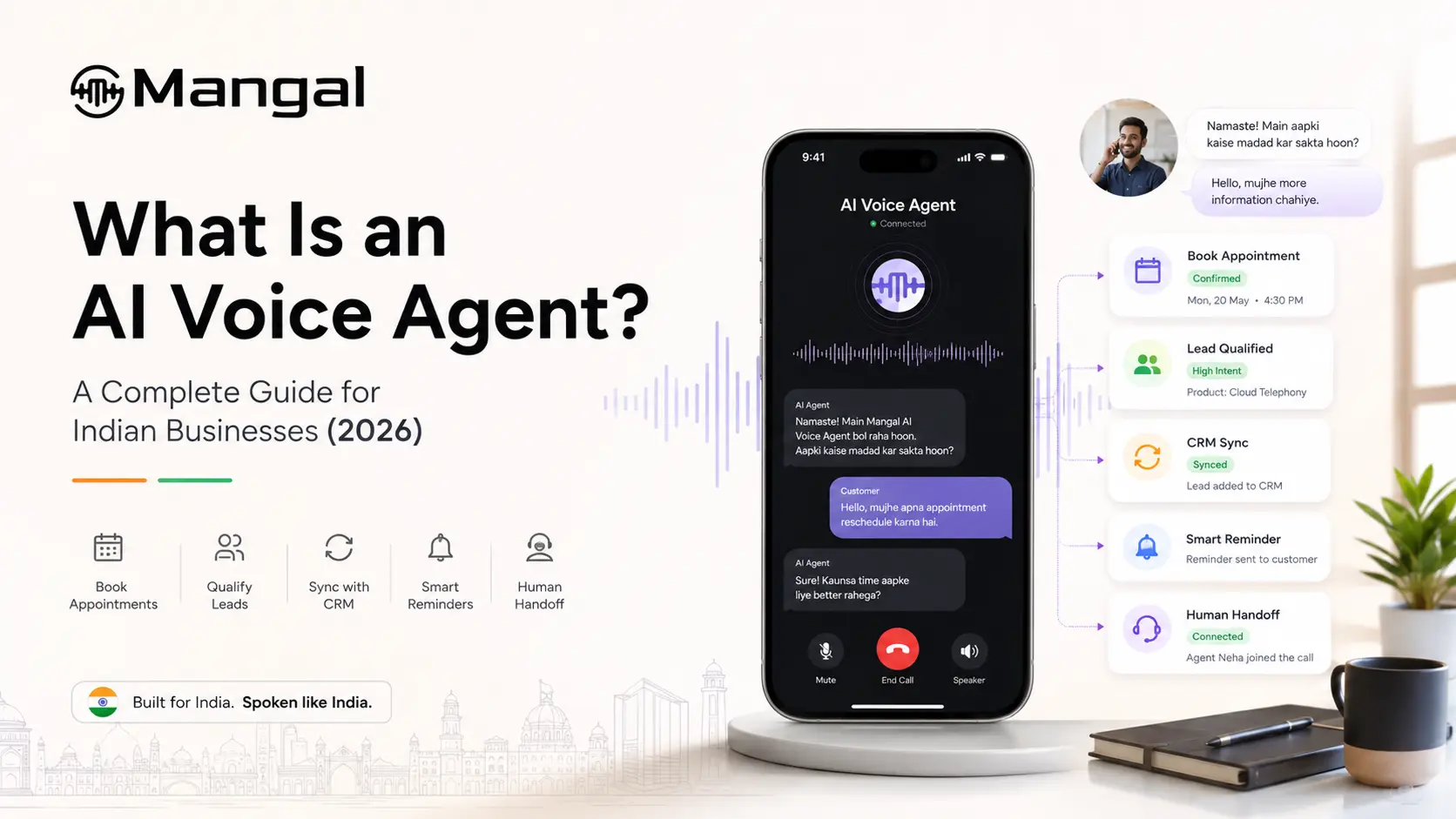
An AI voice agent is an AI system that communicates with customers through phone conversations.
Unlike traditional IVR systems that use fixed menu options, AI voice agents understand spoken conversations and respond dynamically.
An AI voice agent can:
- answer incoming calls
- make outbound calls
- understand customer intent
- collect information
- answer common questions
- schedule appointments
- update business systems
- transfer complex cases to humans
The key difference is that a voice agent can move beyond answering questions.
It can help complete business workflows.
Example:
A customer says:
"I want to schedule a product demo."
An AI voice agent can:
- Understand the request
- Ask relevant questions
- Check availability
- Schedule the meeting
- Update CRM records
- Notify the sales team
This is where voice AI becomes valuable for businesses.
The Real Difference: Answers vs Actions
The biggest difference between chatbots and AI voice agents is what happens after the customer asks something.
Chatbot:
Customer:
"Where can I find your pricing?"
Chatbot:
"Here is our pricing page."
The chatbot provides information.
AI Voice Agent:
Customer:
"I want to understand which solution fits my business."
AI voice agent:
- understands the requirement
- asks follow-up questions
- identifies customer intent
- collects information
- triggers business actions
- transfers to a human if needed
The difference:
Chatbots deliver answers. AI voice agents can turn conversations into actions.
For businesses, those actions may include:
- booking appointments
- qualifying leads
- updating CRM
- sending follow-ups
- routing customers to the right team
When Should Businesses Choose an AI Chatbot?
An AI chatbot is a good choice when customer interactions are mostly information-based.
1. Frequently Asked Questions
Examples:
- pricing information
- product details
- policies
- service information
2. Self-Service Support
Customers can find answers without contacting a support representative.
Examples:
- documentation
- troubleshooting guides
- account information
3. Website Assistance
Chatbots work well for helping visitors:
- find information
- explore products
- understand services
- navigate websites
4. Low-Complexity Queries
If customers only need a quick answer, text automation can be efficient.
When Should Businesses Choose an AI Voice Agent?
Businesses should consider AI voice agents when customer interaction requires conversation.
1. Customer Support Calls
Many customers still prefer phone conversations when they have questions or problems.
Voice agents can handle:
- support enquiries
- status updates
- information requests
- follow-up calls
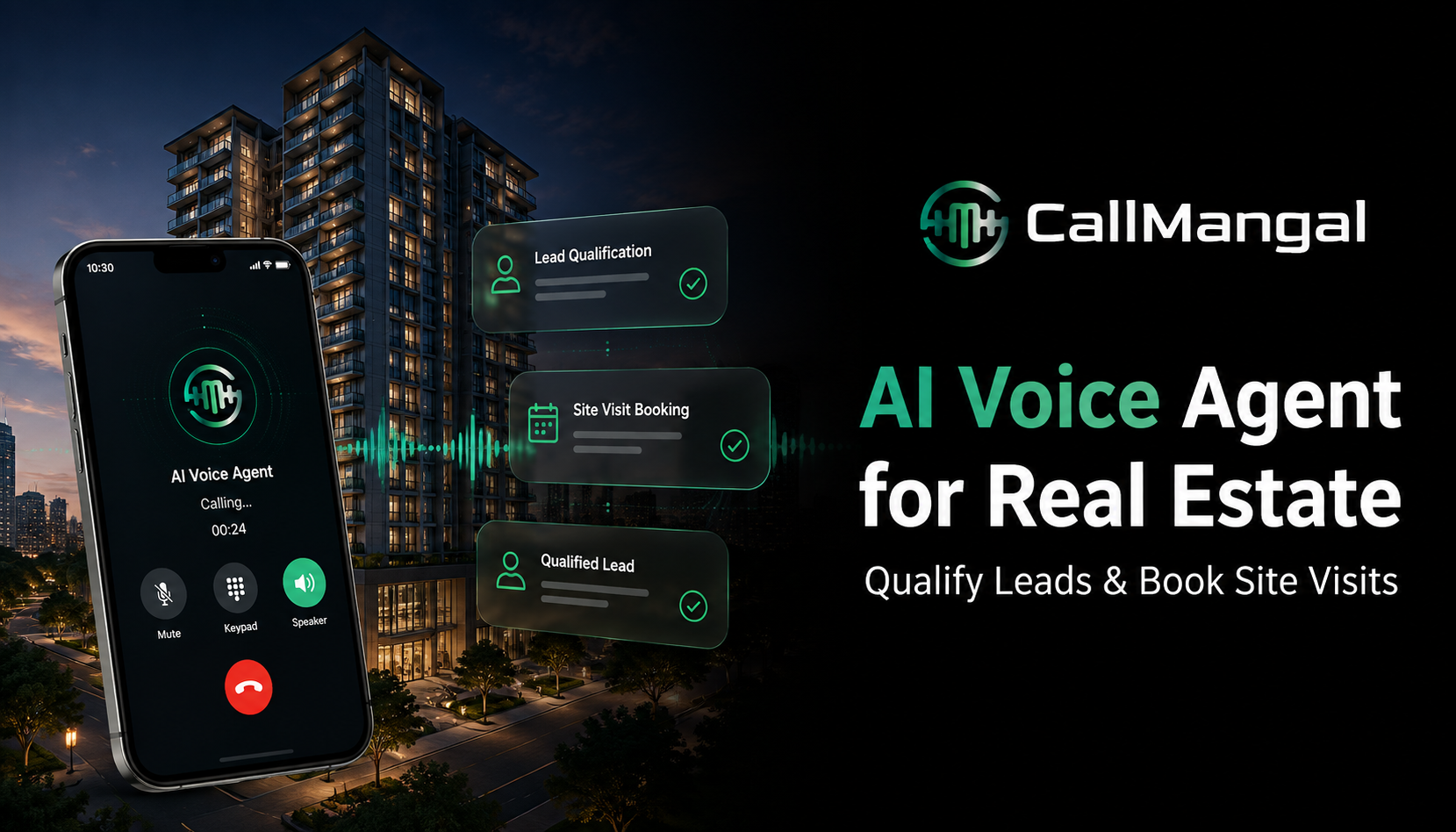
2. Lead Qualification
Sales teams often receive many enquiries, but not every enquiry has the same value.
An AI voice agent can collect:
- customer requirements
- budget
- timeline
- location
- buying intent
Example:
A property buyer says:
"I need a 3-bedroom apartment."
The AI agent can understand:
- preferred location
- budget range
- purchase timeline
- site visit interest
Then send structured information to the sales team.
3. Appointment Booking
Voice conversations are useful when customers need scheduling.
Examples:
- healthcare appointments
- sales demos
- consultations
- property visits
- education counselling
4. Customer Follow-Ups
Businesses often lose opportunities because follow-ups are delayed.
AI voice agents can support:
- lead follow-ups
- reminders
- renewals
- feedback calls
- confirmation calls
Do Businesses Need Both Chatbots and AI Voice Agents?
In many cases, yes.
Businesses do not always need to choose only one.
A combined workflow can look like this:
Customer visits website → Chatbot answers basic questions → Customer shows buying intent → AI Voice Agent follows up → CRM updated → Human handles complex conversationA chatbot can manage simple interactions.
A voice agent can handle conversations that require deeper engagement.
Together, they create a complete customer communication system.
AI Voice Agent vs Human Customer Support Team
AI should support customer teams, not simply replace them.
The strongest customer experiences combine automation with human judgment.
| AI Voice Agent Handles | Human Team Handles |
|---|---|
| First response | Complex problems |
| Common questions | Sensitive situations |
| Lead qualification | Negotiation |
| Appointment scheduling | Decision making |
| Follow-ups | Relationship building |
| Information collection | Strategic conversations |
AI handles repetitive work.
Humans handle situations where empathy, judgment, and expertise matter.
How AI Voice Agents Create Business Value Beyond Support
AI voice agents are not only useful for answering customer questions.
They can support revenue and operational workflows.
Sales Qualification
Example:
A new enquiry arrives.
AI agent:
- contacts the customer
- understands requirements
- qualifies interest
- sends details to sales
Appointment Automation
Example:
A customer wants a consultation.
AI agent:
- understands preferred timing
- schedules appointment
- sends confirmation
- updates calendar
Customer Retention
Example:
Existing customer needs a follow-up.
AI agent:
- contacts customer
- collects feedback
- identifies issues
- escalates when required
Industry Examples
Ecommerce
Chatbot:
- product questions
- return policies
- order information
AI Voice Agent:
- delivery issues
- customer calls
- order follow-ups
Healthcare
Chatbot:
- clinic information
- general questions
AI Voice Agent:
- appointment booking
- reminders
- patient follow-ups
Real Estate
Chatbot:
- project information
- brochure requests
AI Voice Agent:
- buyer qualification
- requirement collection
- site visit scheduling
Education
Chatbot:
- course details
- admission information
AI Voice Agent:
- admission counselling
- enquiry follow-ups
- student communication
SaaS
Chatbot:
- documentation
- product information
AI Voice Agent:
- onboarding calls
- customer support
- renewal conversations
How Should Businesses Choose Between a Chatbot and an AI Voice Agent?
Use this simple decision framework.
Choose a Chatbot if:
- ✓ Customers mainly need information
- ✓ Questions are repetitive
- ✓ Self-service is the goal
- ✓ Text interaction is enough
Choose an AI Voice Agent if:
- ✓ Customers prefer phone conversations
- ✓ Qualification is required
- ✓ Appointment booking matters
- ✓ Follow-ups are important
- ✓ Conversations lead to business actions
Choose Both if:
- ✓ Customers use multiple communication channels
- ✓ You need both self-service and human-like conversations
How Should Businesses Measure AI Support ROI?
The success of AI automation should not only be measured by the number of conversations handled.
Businesses should track:
Customer Experience
- response time
- resolution speed
- customer satisfaction
Sales Impact
- qualified leads
- booked appointments
- follow-up completion
Operational Impact
- reduced repetitive workload
- faster response
- better customer data
The right metrics depend on the business goal.
How CallMangal Helps Businesses Automate Voice Conversations
CallMangal helps businesses manage phone-based customer conversations using AI voice workflows.
Businesses can use AI voice agents for:
- customer support calls
- inbound and outbound calling
- lead qualification
- appointment booking
- follow-ups
- CRM actions
- conversation recordings and transcripts
- human handoff
A typical workflow:
Customer Call → AI Conversation → Intent Understanding → Business Action → CRM Update / Human TransferThe goal is not replacing customer teams.
The goal is helping businesses respond faster, capture better information, and route conversations to the right person.
Frequently Asked Questions
What is the difference between an AI voice agent and a chatbot?
An AI chatbot handles text-based conversations, while an AI voice agent handles spoken phone conversations and can perform actions such as qualification, scheduling, CRM updates, and human escalation.
Is an AI voice agent better than a chatbot?
Neither solution is always better. Chatbots are effective for information-based interactions, while AI voice agents are better for conversations that require understanding and actions.
Can AI voice agents replace customer support teams?
AI voice agents can automate repetitive tasks, but humans remain important for complex issues, negotiations, and relationship-based conversations.
Are AI voice agents suitable for small businesses?
Yes. Small businesses can use AI voice agents to handle customer calls, qualify enquiries, schedule appointments, and reduce repetitive support work.
Should businesses use chatbots and voice agents together?
Many businesses benefit from combining both. Chatbots handle simple text interactions, while voice agents manage conversations requiring deeper engagement.
Final Thoughts
Choosing between an AI chatbot and an AI voice agent depends on the type of customer interaction your business wants to improve.
Choose a chatbot when customers need quick information.
Choose an AI voice agent when customers need conversation, qualification, scheduling, or phone-based support.
For many businesses, the future is not chatbot versus voice agent.
It is using the right AI channel for the right customer moment.
Want to see how an AI voice agent can handle real customer conversations for your business? Try CallMangal and experience AI-powered voice automation.
.webp)