A customer calls your business after office hours, starts speaking in Hindi, switches to English halfway through, asks a follow-up question, and then wants to book an appointment.
A traditional phone menu may struggle with that conversation. An AI voice agent is designed to handle it more naturally.
Instead of forcing callers through “press 1 for sales” menus, a voice agent can listen to what the person says, understand the request, respond in spoken language, access approved business information, take an action, and hand the conversation to a human when needed.
For Indian businesses, that can make voice AI useful for everything from appointment bookings and property enquiries to COD confirmations, lead qualification, reminders, and customer support.
What is an AI voice agent?
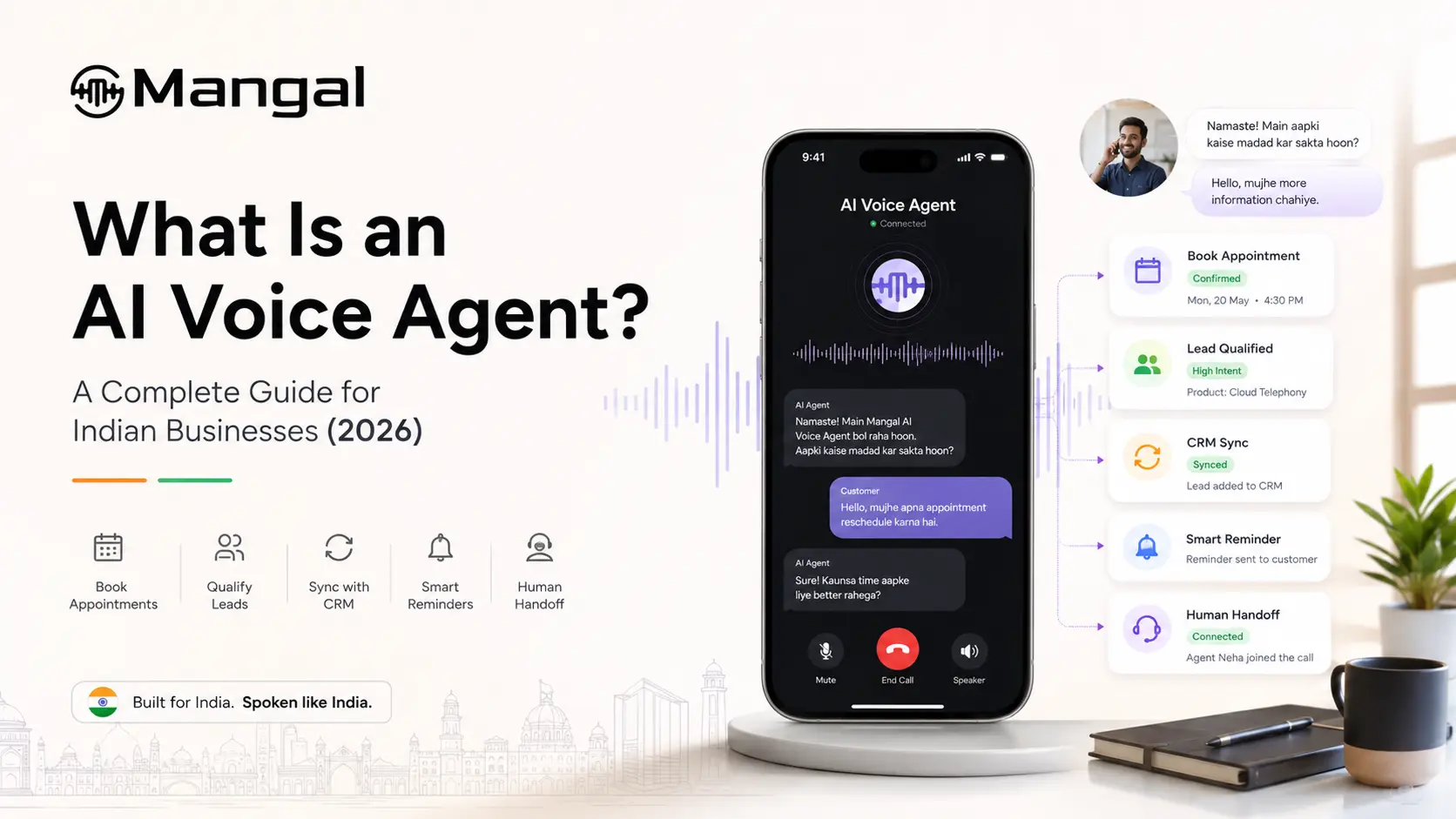
An AI voice agent is software that answers or makes phone calls, understands natural speech, responds using AI, and can perform business actions such as booking appointments, qualifying leads, checking information, updating systems, or transferring a call to a human.
A modern system usually combines speech recognition, conversational AI or a language model, business knowledge, integrations, text-to-speech, and telephony.
You may also see terms such as voice AI agent, AI phone agent, AI calling agent, or conversational voice agent. Vendors use these labels differently, but they generally refer to AI systems designed to conduct spoken conversations.
How does an AI voice agent work?
A voice AI conversation may sound simple to the caller, but several systems work together behind the scenes.
1. The call connects
The conversation starts through a phone line, outbound dialer, SIP connection, browser-based calling interface, or another supported channel. Audio then begins flowing between the caller and the AI system.
2. Speech recognition processes the caller's voice
Automatic speech recognition, also called ASR or speech-to-text (STT), converts the caller's speech into information the system can process.
For example, a customer might say:
“Mujhe kal afternoon ka appointment book karna hai.”
The system needs to understand that the person wants an appointment tomorrow afternoon, not simply transcribe individual words.
Real calls make this harder. People interrupt, pause, speak quickly, use business-specific terms, switch languages, or call from noisy environments.
3. The AI decides what to do next
The conversational or language-model layer looks at:
- what the caller just said;
- previous turns in the conversation;
- the agent's instructions;
- available business information;
- and the actions the agent is allowed to take.
It may decide to answer a question, ask for missing information, check an order, qualify a lead, find an available appointment, update a system, or transfer the caller.
4. Business knowledge and tools complete the task
A useful AI voice agent should do more than generate sentences. Depending on the workflow, it may connect to:
- FAQs and company policies;
- CRM systems;
- calendars;
- order-management software;
- WhatsApp workflows;
- internal databases;
- webhooks or APIs.
This is what allows the agent to move from “talking about the task” to actually completing the next step.
5. Text-to-speech generates the reply
Once the response is ready, text-to-speech (TTS) converts it into spoken audio. A well-tuned system should also support natural turn-taking. If the caller interrupts, the agent should be able to stop, listen, and continue based on the new information.
6. The call is logged or handed off
During or after the call, a production system may save recordings, transcripts, caller details, outcomes, and integration activity. If the request is outside the AI's scope, the safer option is often to transfer the conversation to a human rather than continue guessing.
A simplified AI voice-agent flow
Caller → Telephony → Speech Recognition → AI/Conversation Layer → Business Knowledge & Tools → Text-to-Speech → CallerAlongside this loop sit recordings, analytics, integrations, guardrails, and human escalation.
AI voice agent vs IVR vs human agent
AI voice agents are not simply a newer name for IVR, and they are not automatically a replacement for human teams.
| Capability | Traditional IVR | AI Voice Agent | Human Agent |
|---|---|---|---|
| Natural conversation | Limited | Strong within its scope | Strong |
| Fixed “press 1” menus | Common | Usually unnecessary | No |
| Open-ended questions | Limited | Can handle many | Best |
| 24/7 availability | Yes | Yes | Depends on staffing |
| High-volume routine calls | Good for routing | Strong | Costly to scale |
| Conversation context | Limited | Yes | Yes |
| CRM or system actions | Often rigid | Strong with integrations | Strong |
| Hindi/Hinglish handling | Configuration-dependent | Platform-dependent | Agent-dependent |
| Emotional or sensitive calls | Poor fit | Needs escalation | Best fit |
| Unusual edge cases | Limited | Knowledge-dependent | Usually best |
The most practical model is often: IVR for simple routing, AI for structured conversational work, and humans for situations requiring judgment, empathy, negotiation, or exception handling.
Why do AI voice agents matter for Indian businesses?
Call volume does not always arrive when a team is ready for it.
A property lead may call after office hours. A clinic front desk may already be busy when another patient wants to reschedule. A D2C company may have hundreds of order confirmations. An admissions team may receive a seasonal spike in enquiries.
Voice AI can take over the predictable part of those conversations while keeping humans available for calls where they add more value.
Hindi and Hinglish change the conversation
Indian callers often do not stay in one language throughout a call. A person might begin with:
“Mujhe appointment book karni hai.”
and immediately follow with:
“Actually, do you have anything after 5 PM?”
That means language support should be tested on real code-switching, not only on separate English and Hindi demo scripts.
CallMangal currently supports natural Hindi, English, and mixed Hindi-English conversations.
For a deeper look at this problem, read: Multilingual AI Voice Agents in India: Why Hindi & Hinglish Matter.
Real calls are rarely studio-quality
Indian business calls may happen from shops, traffic, homes, offices, or mobile connections with inconsistent audio. Before deployment, test the agent using the accents, vocabulary, interruptions, background noise, and speaking patterns your actual customers use.
What can an AI voice agent do?
Voice-agent workflows generally fall into two categories.
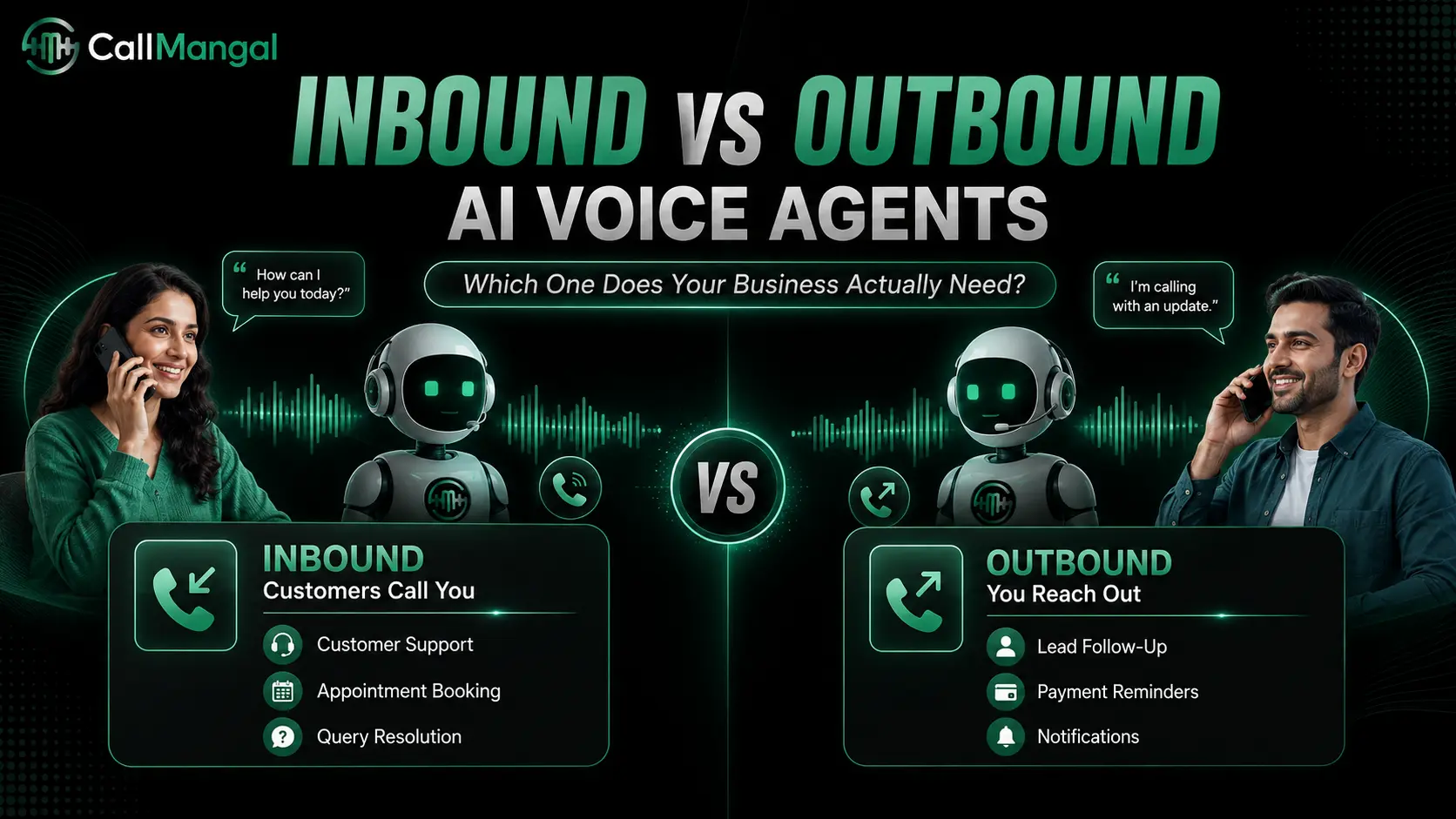
Inbound AI voice agents
Inbound agents answer when the customer calls the business. Common workflows include:
- answering routine support questions;
- qualifying sales enquiries;
- collecting caller information;
- booking or rescheduling appointments;
- checking basic order information;
- routing callers;
- transferring complex conversations to humans.
Outbound AI voice agents
Outbound agents initiate calls for a defined workflow. Examples include:
- COD order confirmations;
- appointment reminders;
- payment or renewal reminders;
- lead follow-up;
- document follow-ups;
- customer feedback;
- scheduled updates.
For a deeper comparison, see: Inbound vs Outbound AI Voice Agents: Which Should You Start With?
AI voice agent use cases in India
The best first use cases usually have a clear objective and a repeatable conversation structure.
| Industry | Common AI voice workflow | Typical reason for human handoff |
|---|---|---|
| Healthcare | Appointment booking, reminders, routing | Sensitive or unusual patient request |
| Real Estate | Lead qualification, requirement capture, site visits | Serious buyer or negotiation |
| Retail & D2C | COD confirmation, delivery updates, follow-ups | Order exception or complaint |
| Education | Admission enquiries, counselling scheduling, reminders | Detailed counselling |
| BFSI | Payment reminders, renewals, document follow-up | Account-specific or sensitive issue |
| Travel & Hospitality | Booking confirmations, reminders, basic support | Urgent or complex service problem |
The purpose is not to automate every call. It is to automate the calls where the conversation has a clear structure and outcome.
See more examples on the CallMangal use cases page.
What are the benefits of AI voice agents?
Faster response
An AI voice agent can answer or initiate a structured conversation without waiting for a team member to become available. That is useful during peak hours and for enquiries arriving outside normal working hours.
24/7 coverage
Selected workflows can remain available outside office hours without requiring the full human team to work around the clock.
Less repetitive work
Order confirmations, appointment reminders, routine qualification, and basic information requests can consume a significant amount of operational time. Automating those predictable conversations gives human teams more time for exceptions and high-value interactions.
More consistent information capture
A configured voice agent can ask the required questions on every relevant call and store the answers in a consistent format.
Better connection between calls and follow-up
Voice AI becomes more useful when the conversation triggers the next action. That may include:
CRM update → calendar booking → WhatsApp follow-up → internal API actionRather than simply recording a message for someone to handle later.
Where do AI voice agents still struggle?
A realistic evaluation should include failure cases, not only polished demos.
Ambiguous requests
Customers do not always explain their problem clearly. The agent needs to know when to clarify and when to escalate.
Missing or incorrect business knowledge
If reliable information is not available, the system should not invent an answer.
Sensitive conversations
Complaints, emergencies, negotiations, and emotionally charged situations often need a human.
Poor audio
Background noise and weak call quality can make speech recognition and turn-taking more difficult.
Integration failures
The conversation can work perfectly while the booking, CRM update, or API action fails. The workflow needs a fallback rather than telling the caller an action succeeded when it did not.
Over-automation
A conversation should not remain with AI merely because the AI can technically continue. Good implementations define exactly when the AI should stop and hand over.
How much does an AI voice agent cost in India?
There is no single industry-standard price. Voice AI platforms may charge based on:
- conversation minutes;
- call volume;
- monthly platform fees;
- concurrent calls;
- number of agents;
- telephony;
- voice or model quality;
- integrations;
- implementation;
- managed support;
- enterprise deployment requirements.
When comparing platforms, look beyond the headline per-minute rate. The more useful question is:
What is the total cost of completing this workflow?
Check whether telephony, recordings, transcripts, integrations, setup, support, and minimum usage commitments are included.
CallMangal uses published per-minute plans alongside enterprise options. For the latest rates and plan conditions, see the CallMangal pricing page.
What should you look for in an AI voice agent platform?
A good demo call is useful, but it should not be your entire evaluation.
Conversation quality
Test whether the system can handle normal interruptions, pauses, corrections, and follow-up questions. The customer should not have to learn how to speak to the AI.
Hindi and Hinglish quality
If your customers speak both Hindi and English, test genuine code-switching. Do not evaluate multilingual performance only through translated scripts.
Business knowledge
Check how the agent gets its answers. Can you control the information it uses? Can your team update it when products, policies, pricing, or processes change?
Integrations
Determine whether the agent can perform the action required during the call. Examples:
- update a CRM;
- schedule an appointment;
- trigger an API;
- send follow-up information;
- route a qualified lead.
You can review CallMangal's available connection options on the integrations page.
Human handoff
Ask four questions:
- What triggers a transfer?
- What information is passed to the human?
- Does the customer need to repeat the conversation?
- What happens if no human is available?
Recordings and analytics
Useful operational data may include:
- recordings;
- transcripts;
- caller details;
- call duration;
- outcomes;
- lead status;
- integration activity.
Guardrails
Define what the AI can say, which actions it may perform, and when it must escalate.
How should you implement your first AI voice agent?
Do not start with the hardest conversation in your company. Start with a workflow where success is easy to define.
A practical rollout looks like this:
- Choose one repeatable call type.
- Define the desired outcome.
- Document how a strong human agent handles it.
- Identify the business data and systems required.
- Define human-escalation conditions.
- Test realistic happy paths and edge cases.
- Launch on controlled traffic.
- Review recordings and transcripts.
- Improve knowledge, instructions, and routing rules.
- Expand only after the first workflow is stable.
A narrow first project makes failures easier to diagnose and success easier to measure.
How do you measure whether an AI voice agent is working?
Do not judge an AI voice agent only by how human the voice sounds. Measure whether it completes the business task.
Depending on the workflow, useful metrics include:
- Call completion rate — did the intended conversation reach an outcome?
- Resolution or containment rate — did the workflow finish without unnecessary escalation?
- Human-transfer rate — how often are conversations transferred, and why?
- Lead qualification rate — how many relevant conversations produce qualified opportunities?
- Appointment booking rate — how many eligible callers successfully book?
- Follow-up completion rate — did the required CRM, calendar, WhatsApp, or API action happen?
- Average handling time — how long does a successful workflow take?
- Failure rate — how often do recognition, integrations, or business rules fail?
The best metric depends on the job. A payment-reminder agent and a real-estate lead-qualification agent should not be judged using the same KPI.
What compliance should businesses consider for AI voice calling in India?
Compliance should be designed into the workflow rather than added after launch. Requirements can vary depending on:
- whether the call is inbound or outbound;
- the purpose of the communication;
- the relationship with the recipient;
- consent and customer preferences;
- whether calls are recorded;
- what personal data is processed;
- how long information is retained;
- the business's industry;
- and the telecom setup being used.
Businesses should review the telecom, commercial-communication, privacy, recording, and sector-specific requirements that apply to their deployment. For regulated or sensitive use cases, involve your legal or compliance team before going live.
An AI voice platform should be treated as a tool within your compliance process, not as a replacement for that process.
A real CallMangal deployment example
One early CallMangal real estate pilot started with a narrow workflow: handling incoming property enquiries.
The workflow
The agent was configured to:
- receive inbound property enquiries;
- collect buyer requirements;
- qualify initial interest;
- schedule site visits;
- and move serious prospects to the sales team.
Calls remained available for review through recordings and transcripts.
The rollout
The pilot moved from workflow configuration and testing to handling inbound customer enquiries in approximately two weeks.
That should not be treated as a universal implementation benchmark. Deployment time depends on workflow complexity, integrations, testing requirements, and business approvals.
The useful lesson is the approach:
Start with one clear workflow, connect the systems it needs, test realistic calls, and expand after the process becomes stable.
Frequently asked questions about AI voice agents
Is an AI voice agent the same as an IVR?
No. A traditional IVR usually sends callers through predetermined menus such as “press 1 for sales.” An AI voice agent can understand natural spoken requests and continue a conversation without requiring every possible path to be represented by a keypad option.
What is the difference between an AI voice agent and an AI phone agent?
In most business contexts, AI voice agent, AI phone agent, voice AI agent, and AI calling agent describe closely related technology. The label matters less than the capabilities. Check whether the platform supports natural conversations, integrations, business actions, analytics, and human escalation.
Can AI voice agents speak Hindi and Hinglish?
Some platforms can. The important question is not whether “Hindi” appears in a feature list but how the system performs when customers naturally switch between Hindi and English. CallMangal supports 32+ languages, including 12 Indian languages such as Hindi, Gujarati and Marathi, and handles mixed Hindi-English conversations.
Can AI voice agents handle inbound and outbound calls?
Yes, depending on the platform. Inbound voice agents answer customer calls, while outbound agents initiate workflows such as reminders, confirmations, qualification, and follow-ups.
Can an AI voice agent transfer a call to a person?
A production system should provide a human escalation path. Transfers can be triggered by customer request, workflow rules, sensitive topics, missing information, or situations the AI is not configured to handle.
Will AI voice agents replace human call-centre teams?
Not for every conversation. Voice AI is best suited to structured, repetitive, and high-volume workflows. Humans remain important for unusual cases, sensitive discussions, negotiation, complex troubleshooting, and conversations requiring judgment.
How much does an AI voice agent cost in India?
Pricing depends on usage, platform, telephony, model or voice quality, integrations, setup, support, and deployment requirements. Compare total workflow cost instead of looking only at the headline per-minute price.
What is the best first use case for an AI voice agent?
Start with a high-volume workflow with a clear outcome and limited ambiguity. Appointment booking, lead qualification, order confirmation, and structured reminder calls are common examples.
Ready to hear an AI voice agent on a real call?
Reading about voice AI can explain the architecture. A real conversation shows whether the experience actually works.
Mangal supports inbound, outbound, and browser-based voice conversations, along with Hindi-English calling, recordings, transcripts, connected business actions, and human handoff.
Try a Live Call or Book a Live Demo using a real business workflow you want to automate.
.webp)