The host is seating a walk-in. Two delivery drivers are waiting at the counter. A server needs the manager, and the kitchen is already backed up.
Then the phone rings.
One caller wants a table for four at 8:00. Another wants to place a takeout order. A third just wants to know whether the restaurant is open on Labor Day.
None of those calls is particularly difficult.
The problem is that they arrive when restaurant staff has the least time to answer them.
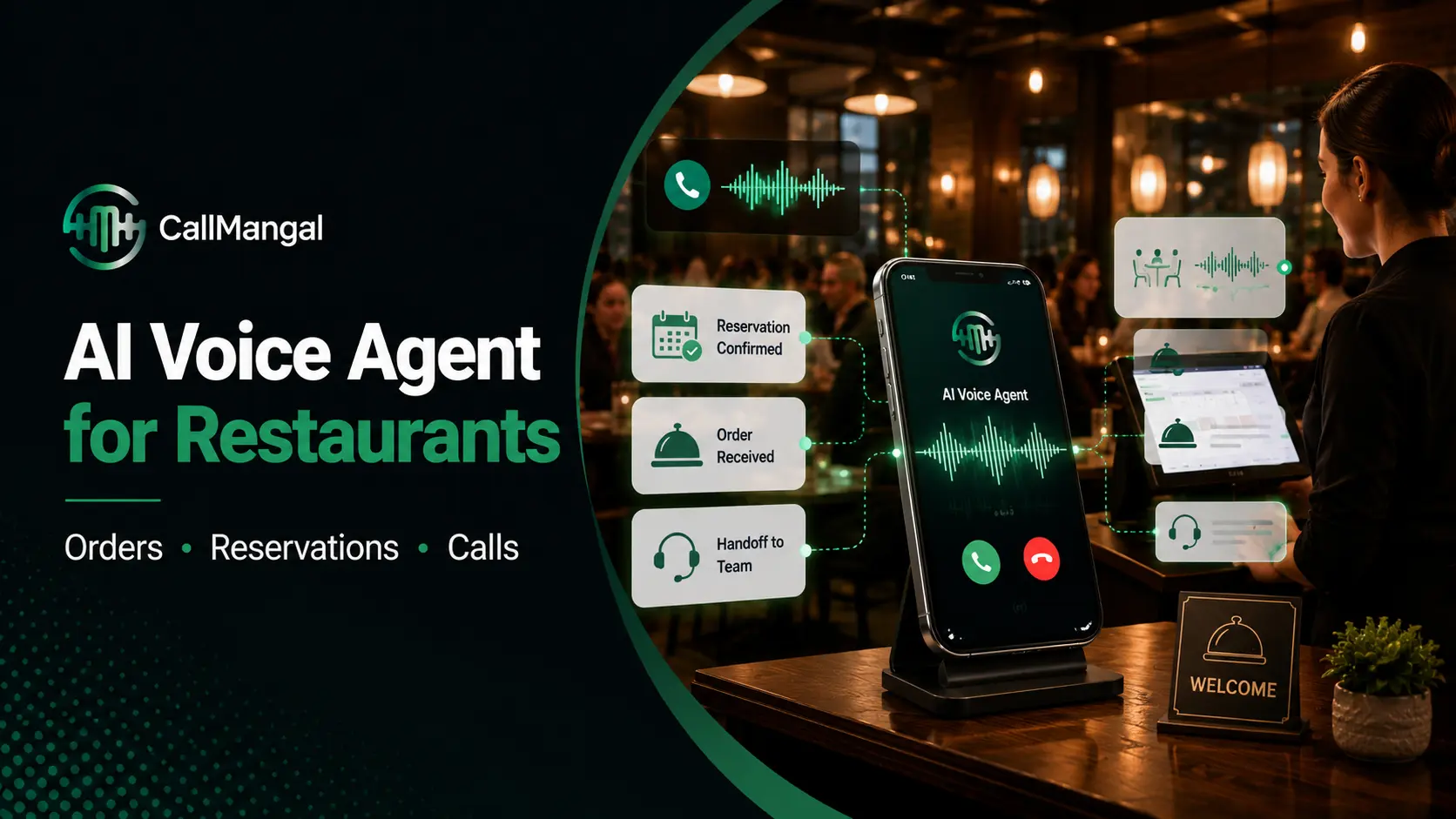
An AI voice agent for restaurants can answer incoming calls, understand why someone is calling, and handle repeatable tasks such as reservations, takeout requests, menu questions, hours, directions, order-status inquiries, and call routing.
The real test, however, is not whether the AI can answer the phone.
It is whether it can complete the call correctly when the restaurant is busy, the caller changes their mind, the menu changes, or the conversation does not follow a neat script.
What Is an AI Voice Agent for Restaurants?
A restaurant AI voice agent is software that handles phone conversations using natural language instead of forcing callers through a traditional "press 1, press 2" menu.
A customer can say:
"Do you have anything around 7:30 for five people?"
The voice agent can identify the request as a reservation, ask for any missing details, check availability if it has access to the appropriate system, confirm the booking, and trigger a follow-up.
Another customer may ask:
"Are you open tomorrow, and do you have gluten-free pizza?"
That is a different task. The agent needs accurate restaurant information rather than a reservation workflow.
A useful voice agent therefore needs to do more than convert speech into text. It has to understand the caller's intent, use the right information, take the correct action, and recognize when a restaurant employee should take over.
For a deeper look at the technology behind these systems, read our guide to AI voice agents.
What Restaurant Calls Can an AI Voice Agent Handle?
Most restaurant calls fall into a relatively small number of patterns.
| Caller request | What the AI can do | When staff may be needed |
|---|---|---|
| "What time do you close?" | Answer from current business information | Holiday hours are unclear |
| "Table for four at 8:00" | Collect details and check availability | Large party or special event |
| "Can I move my reservation?" | Find and update a booking | Reservation cannot be located |
| "I want to place a takeout order" | Build and confirm an order | Request falls outside menu rules |
| "Does this dish contain dairy?" | Retrieve approved menu information | Allergy information is uncertain |
| "Where is my order?" | Look up or route the request | Order data is unavailable |
| "Do you deliver to my ZIP code?" | Check delivery rules | Address falls outside known zones |
| "Can you cater 80 people?" | Collect event details | Pricing or custom planning is needed |
| "I need to speak to a manager" | Route the call | Human should take over |
| "I left my wallet there last night" | Collect details or route appropriately | Staff needs to investigate |
This is a more useful way to evaluate restaurant phone automation than simply asking whether an AI system can "answer calls."
The better question is:
How many common calls can it finish without creating extra work for the restaurant?
Where Restaurant Voice Agents Create the Most Value
Not every restaurant needs to automate every phone call.
The highest-value starting points are usually the calls that are frequent, predictable, and disruptive to front-of-house staff.
Peak-hour overflow
A restaurant may be fully staffed and still struggle with the phone during dinner service.
A voice agent can answer overflow calls while employees stay focused on guests already inside the restaurant.
After-hours calls
People do not always call during business hours.
An AI agent can answer basic questions, collect reservation requests, or capture catering inquiries even when the restaurant is closed.
Repetitive questions
Hours, parking, directions, reservation policies, menu questions, delivery zones, and similar requests can consume a surprising amount of staff time.
These are usually better automation candidates than conversations requiring judgment.
Missed reservation and order opportunities
A missed call can be more than an inconvenience.
It may represent a reservation, takeout order, catering inquiry, or customer who simply calls another restaurant instead.
The value of a voice agent is often less about "replacing phone staff" and more about making sure routine opportunities do not disappear when nobody can pick up.
Taking Restaurant Orders Is Harder Than Transcribing a Call
A phone order is not just a conversation.
It is structured data.
Consider this request:
"I need two large pepperoni pizzas. Extra cheese on one, no olives on the other, and make the second one thin crust. Pickup around 7:45."
A working order-taking system has to separate that request into fields such as:
- Item
- Quantity
- Size
- Crust
- Modifiers
- Removals
- Pickup or delivery
- Requested time
Then it has to determine whether those combinations are actually valid.
If an item is sold out, the agent should not invent a substitute.
If a modifier changes the price, the system should use the restaurant's real pricing rules.
If the caller changes their mind, the order state has to change with them.
For example:
"Actually, make the second pizza medium and add mushrooms."
The system should update the existing second pizza, not accidentally add another one.
That kind of order-state handling matters much more in production than whether the voice sounds impressive in a demo.
The final read-back is critical
Before an order is submitted, the important details should be confirmed.
For example:
"I have two pepperoni pizzas for pickup. The first is large with extra cheese. The second is medium, thin crust, no olives, with mushrooms. You requested pickup at 7:45. Is that correct?"
A confirmation step can catch mistakes before they reach the kitchen.
Menu Freshness Matters More Than a Perfect Voice
An AI voice can sound completely natural and still give the wrong answer.
Imagine that the agent confidently recommends tonight's salmon special.
The kitchen sold out 20 minutes ago.
Restaurant information changes constantly:
- Daily specials
- Sold-out items
- Prices
- Holiday hours
- Promotions
- Delivery zones
- Prep times
- Reservation availability
The voice agent needs a reliable source of truth.
Stable information such as parking instructions or general policies may come from a restaurant knowledge base.
Dynamic information such as live availability, inventory, order status, or changing prices should come from systems that are kept current.
Before launch, restaurant teams should be able to answer four questions:
- Where does the current information live?
- Who is responsible for updating it?
- How quickly do changes reach the voice agent?
- What should the AI do when information is missing or contradictory?
A natural voice cannot compensate for stale data.
Food Allergy Questions Need Stricter Rules
Allergy-related calls should not be treated like ordinary menu questions.
A voice agent may be able to provide allergen or ingredient information explicitly supplied by the restaurant.
It should not infer ingredients that are not documented.
There is an important difference between:
"Our menu marks this dish as containing dairy."
and:
"I guarantee this dish is completely safe for your allergy."
The second statement may depend on information the AI does not have, including preparation methods or cross-contact conditions in the kitchen.
Restaurants can configure these calls so that the AI provides approved information and routes uncertain or higher-risk questions to trained staff.
The important part is setting that boundary before the agent begins taking real calls.
How Restaurant Reservation Calls Should Work
Reservation calls look easy when plenty of tables are available.
The edge cases are what matter.
A standard booking may require:
- Party size
- Date
- Time
- Guest name
- Phone number
Then the caller says:
"Actually, make that seven people."
Or:
"Can we sit outside?"
Or:
"We need two high chairs."
Or:
"It's for 18 people. Do you have a private room?"
Those are no longer identical reservation requests.
A useful workflow should distinguish between a routine booking and a request that requires staff judgment.
When the voice agent is connected to a reservation system or another source of live availability, it can check open times and complete eligible bookings during the call.
If live availability is not accessible, the agent should not pretend the reservation is confirmed.
It can collect the request, trigger a follow-up, or transfer the caller according to the restaurant's process.
The Calls That Should Go to a Human
The goal is not to automate every conversation.
Some calls become more valuable when the AI stops trying to handle them.
| Situation | Recommended action |
|---|---|
| Restaurant hours | AI handles |
| Standard reservation | AI handles |
| Routine takeout order | AI handles when ordering workflow supports it |
| Customer asks for manager | Transfer |
| Serious complaint | Transfer with context |
| Allergy information is uncertain | Escalate |
| Large catering opportunity | Capture details and route |
| Private dining inquiry | Route based on restaurant policy |
| Caller repeatedly corrects the AI | Transfer |
| Request falls outside configured scope | Transfer |
| Restricted payment or account issue | Follow approved secure process |
A good handoff should also preserve context.
The customer should not have to repeat the entire conversation to the restaurant employee who takes over.
Where the system allows it, staff should receive information such as:
- Who is calling
- Why they called
- What information has already been collected
- Where the conversation became difficult
That makes handoff part of the workflow instead of a failure state.
Peak-Hour Calls Change the Economics
Restaurant phone demand often peaks at the exact moment staff attention is already stretched.
Friday at 7:00 p.m. may bring:
- Walk-ins
- Table turns
- Takeout orders
- Delivery pickups
- Reservation calls
- Order-status questions
- Staff requests
Hiring another employee may help with workload, but it does not automatically solve simultaneous phone calls.
This is why some restaurants use AI as overflow rather than trying to replace the main phone workflow.
A restaurant could start by routing only:
- Calls that staff cannot answer
- After-hours calls
- Basic information requests
- Reservation requests
- Specific repeatable call types
Starting narrow can make it easier to test the system and identify where automation is actually useful.
Multilingual Restaurant Calls Need Real Testing
A language-support list on a software website does not tell you whether the system can handle an actual restaurant call.
Customers may switch languages halfway through a sentence.
They may use an English menu item inside a Hindi sentence.
They may pronounce a dish name, neighborhood, or surname in a way the speech system has not seen before.
A real call might sound like:
"Bhaiya, kal 8 baje four people ke liye table milega?"
Then the same customer could add:
"Actually 8:30 kar do, aur outdoor seating available hai?"
Or during an order:
"One paneer tikka, but less spicy karna, and pickup twenty minutes mein."
For multilingual restaurants, these are the conversations worth testing.
Do not stop at:
"Does the system support Hindi?"
Test whether it can:
- Handle code-switching
- Recognize restaurant terminology
- Understand names
- Process interruptions
- Follow a caller who changes details
- Maintain context across languages
CallMangal has a separate guide on Hindi, Hinglish, and multilingual AI voice agents.
How Restaurant Voice Agents Integrate With Other Systems
Integration is where a voice agent moves from answering questions to completing work.
Depending on the restaurant's workflow, an AI agent may need to exchange information with:
- POS software
- Reservation systems
- Calendars
- Messaging tools
- Customer records
- Internal ordering systems
- Webhooks or APIs
An order workflow might look like this:
Caller → Voice agent → Order validation → Restaurant system → ConfirmationA reservation flow might look like:
Caller → Voice agent → Availability check → Booking → ConfirmationThe important question is not simply:
"Does this platform support integrations?"
It is:
"Can this exact workflow connect to the system our restaurant already uses?"
Some systems expose APIs that make automation easier.
Others may limit what outside tools can read or update.
Those limitations should be identified before deployment.
CallMangal supports broader business integrations through connected systems, webhooks, and APIs. You can review the available CallMangal integrations to understand the current options.
The 20-Call Test to Run Before Launch
A polished product demo is not enough.
Before routing a real restaurant number to an AI voice agent, test it with deliberately messy calls.
Five normal calls
Start with:
- Restaurant hours
- Straightforward reservation
- Standard takeout order
- Directions
- Common menu question
These establish the baseline.
Five realistic calls
Now make the conversation less perfect:
- Call from a noisy environment
- Use speakerphone
- Interrupt the agent
- Speak quickly
- Change an answer midway through the conversation
Five restaurant edge cases
Try:
- Sold-out menu item
- Fully booked time slot
- Food-allergy question
- Large party request
- Complaint that should reach a manager
Five failure-recovery calls
Finally, try to break the workflow:
- Stay silent
- Give an unclear date
- Switch languages
- Correct the same detail twice
- Ask something completely outside the configured scope
The goal is not to prove that the agent never fails.
Every system will eventually encounter something it cannot handle.
What matters is how it fails.
Does it ask a useful clarification question?
Does it confirm important details?
Does it invent an answer?
Does it repeat itself?
Does it recognize when a human should take over?
That tells you much more about production readiness than a successful scripted demo.
Metrics Restaurants Should Track After Launch
"Calls answered" is not enough.
An AI agent could answer 1,000 calls while still frustrating customers or creating incorrect orders.
Measure the outcome of the calls instead.
| Metric | What it tells you |
|---|---|
| Task completion rate | Did callers accomplish what they called about? |
| Reservation completion rate | How many reservation calls reached a completed booking? |
| Order completion rate | How many eligible ordering calls were completed? |
| Handoff rate | How often did staff need to take over? |
| Correct handoff rate | Were the right conversations escalated? |
| Correction rate | How often did customers have to correct information? |
| Abandonment rate | How many callers ended the call before resolution? |
| Response latency | Did the conversation feel natural or slow? |
| Failure reasons | Which intents still cause problems? |
Failed calls are particularly useful.
Successful calls tell you what already works.
Failed calls show you what to improve next.
How to Calculate the ROI of a Restaurant AI Voice Agent
Do not build the business case around a generic industry statistic.
Use your own restaurant's numbers.
One useful starting point is missed-call revenue.
Estimated monthly recovered revenue:
Missed calls × percentage that are revenue-related × conversion rate × average order or reservation value
You can also estimate staff time.
Estimated staff time spent on routine calls:
Routine calls per month × average call duration
Then translate that into labor cost using the actual hourly cost for employees who normally answer those calls.
The goal is not to prove that AI is always cheaper.
It is to determine whether automating specific phone tasks creates enough value to justify the system.
Restaurant groups should also account for:
- Software fees
- Usage charges
- Telephony
- Integration work
- Ongoing maintenance
- Human coverage for escalations
You can review current CallMangal pricing when estimating the platform side of the equation.
How Much Does an AI Voice Agent for a Restaurant Cost?
There is no useful universal price for restaurant voice automation because implementations can differ dramatically.
An agent that only answers business-hour questions is not the same as one that handles reservations, takes orders, sends follow-ups, routes calls across locations, and connects to external systems.
When comparing costs, look at the complete setup.
Platform cost
What does the voice-agent software cost?
Usage
Are call minutes, telephony, phone numbers, or other usage billed separately?
Integration
Does the restaurant need custom API or workflow work?
Maintenance
Who updates menus, operating rules, routing, and knowledge?
Human escalation
Who handles conversations the AI cannot complete?
A low advertised price can still become expensive if the restaurant requires extensive integration work.
The opposite can also be true: a more capable deployment may justify its cost if it recovers enough reservations, orders, or staff time.
AI Voice Agent vs. IVR vs. Human Answering
Different restaurants need different approaches.
| Capability | Traditional IVR | AI voice agent | Human staff |
|---|---|---|---|
| Natural conversation | Limited | Strong when configured well | Strong |
| Routine questions | Basic | Strong | Strong |
| Simultaneous calls | Depends on setup | Strong | Limited by staffing |
| Complex judgment | Weak | Limited | Strong |
| Structured automation | Limited | Strong with integrations | Usually manual |
| Difficult customer conversations | Weak | Limited | Strong |
| After-hours availability | Yes | Yes | Requires staffing |
| Contextual handoff | Limited | Possible | Native |
A human answering service may still be the better choice when most calls require judgment, empathy, or exceptions that cannot be represented in a repeatable workflow.
For many restaurants, the strongest setup is a combination:
AI handles predictable calls. People handle judgment-heavy calls.
When a Restaurant Probably Does Not Need a Voice Agent
Some restaurants will not get enough value from one.
The business case may be weak if phone volume is very low and most guests already order or book online.
A voice agent may also be a poor fit when:
- Menu information changes constantly, and nobody keeps the source data current
- Most phone orders require decisions that cannot be represented in the ordering system
- Nobody is available when the AI needs to escalate a call
- The restaurant's systems cannot provide the data needed to complete key workflows
- The team has not decided which actions the AI is allowed to take
Automation tends to expose unclear processes.
If the restaurant does not have a consistent way to handle a request today, automating that request will usually make the problem more obvious.
Start with a process that is already repeatable.
Where CallMangal Fits
CallMangal is built for business calling workflows rather than being a restaurant-specific POS platform.
It can be configured for inbound and outbound calls, multilingual conversations, recordings and transcripts, human handoff, and follow-up actions through connected business systems.
For a restaurant, the right setup depends on the existing phone workflow.
A single-location restaurant that wants overflow answering may need something simple.
A restaurant group that expects the AI to access live information, route calls between locations, trigger messages, and update external systems will need a more connected implementation.
One useful exercise is to review a week of incoming calls and place them into three categories:
AI can finish this
Examples: hours, directions, routine reservations, common menu questions.
AI can start this, but a person finishes it
Examples: large catering inquiries, unusual requests, private dining leads.
A person should handle this immediately
Examples: serious complaints, uncertain allergy questions, complex management issues.
That exercise usually produces a much better first deployment plan than starting with a long software feature list.
Frequently Asked Questions
Can an AI voice agent take restaurant orders over the phone?
Yes, if the agent has accurate menu information and a workflow for validating items, quantities, modifiers, pricing, and fulfillment details. For production use, important order details should be confirmed before the order is submitted.
Can an AI voice agent book restaurant reservations?
Yes. It can collect booking information and, when connected to a system that provides live availability, check times and create eligible reservations during the call. Requests outside the restaurant's normal booking rules should be routed appropriately.
Can a restaurant AI agent answer allergy questions?
It can provide allergen or ingredient information explicitly supplied by the restaurant. It should not infer missing information or make safety guarantees when the available data is uncertain.
Can an AI voice agent answer multiple restaurant calls at the same time?
Voice systems can be configured to handle concurrent calls, subject to the limits of the telephony and voice infrastructure being used. This can make them particularly useful for peak-hour or overflow answering.
Can restaurant voice AI handle multiple languages?
That depends on the underlying voice system and configuration. Restaurants should test real conversations involving accents, names, menu terminology, interruptions, and language switching rather than relying only on a supported-language list.
Does an AI voice agent replace the restaurant host?
It does not have to. Many restaurants can use AI for overflow, after-hours calls, routine questions, reservations, and other repeatable tasks while staff continues handling conversations that require judgment.
What happens when the AI cannot understand a customer?
A well-designed workflow should clarify the request when possible and escalate or transfer the call when it cannot confidently complete the task. Repeated guessing should not be the fallback strategy.
How long does a restaurant AI voice agent take to set up?
It depends on the workflow. A basic information-answering agent can be much simpler than a system connected to live reservations, ordering, customer data, messaging, or multiple locations. Integration and testing often determine the real deployment timeline.
Do Not Judge a Restaurant Voice Agent by the Perfect Call
Almost every modern voice platform can sound impressive when the caller speaks clearly and follows the expected script.
Restaurants rarely operate under those conditions.
Customers call from cars.
They interrupt.
They change a party of four to a party of seven.
They pronounce menu items differently.
They ask about something that sold out 15 minutes ago.
They switch languages.
They complain.
They ask questions nobody thought to put in the demo script.
That is where the quality of a restaurant AI voice agent becomes visible.
Do not evaluate the system only by how natural the voice sounds.
Give it your actual menu.
Test your busiest call types.
Interrupt it.
Change your mind midway through an order.
Ask a question it should not answer.
Then see whether it keeps the conversation accurate, confirms what matters, and knows when a restaurant employee should take over.
If you want to test how CallMangal handles your restaurant's actual call workflow, explore CallMangal or review the available integrations before deciding which parts of your phone operations are worth automating.