One of the first questions teams ask about voice AI sounds simple:
Do we need AI for calls coming in, or calls going out?
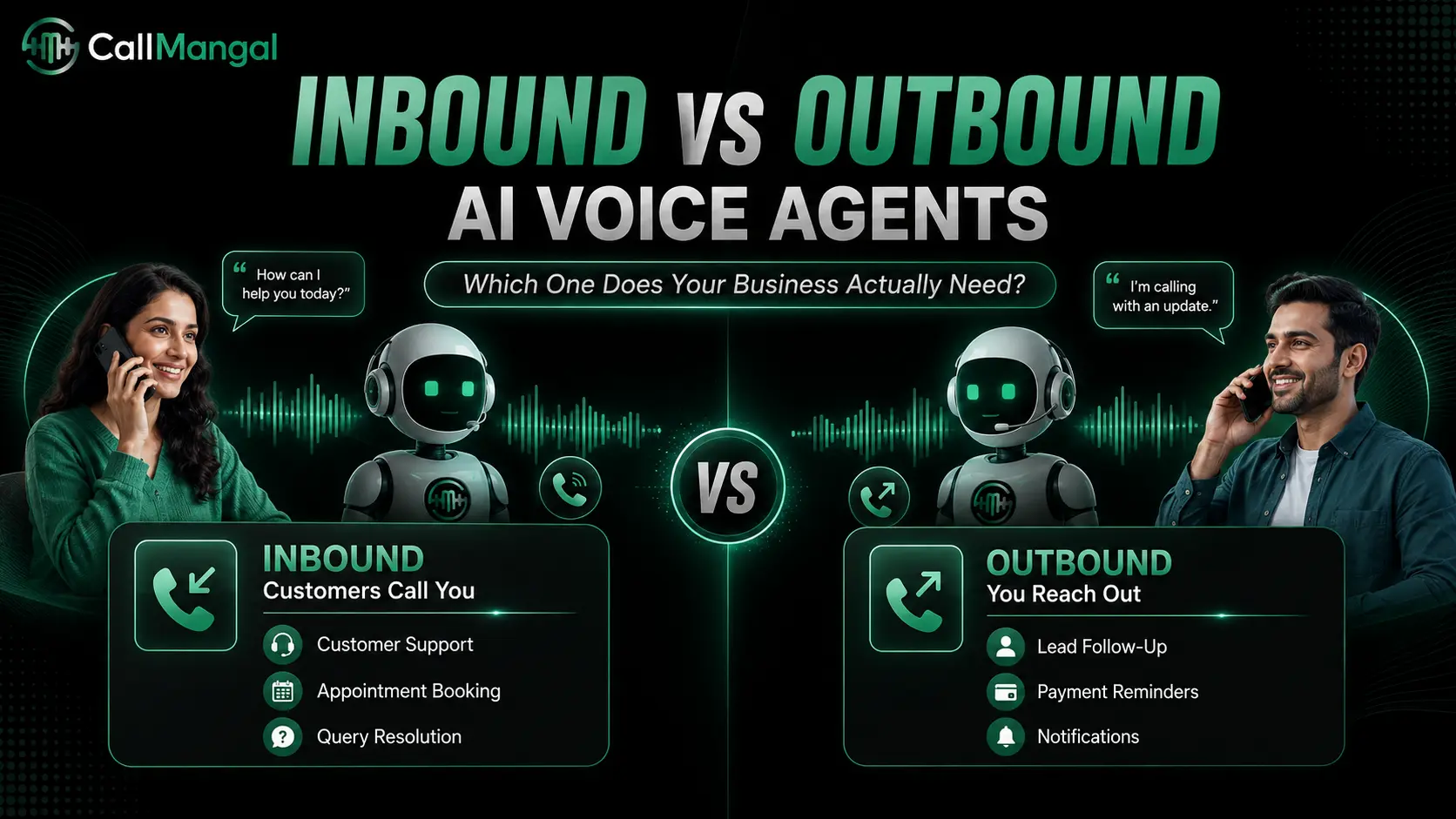
Inbound AI voice agents answer calls that customers initiate. Outbound AI voice agents place calls on behalf of the business.
But choosing between them is not only about call direction.
The two workflows differ in customer intent, conversation design, integrations, success metrics, compliance requirements, and rollout strategy.
Starting with the wrong workflow can waste implementation effort and make it harder to prove business value.
If you need the foundation first, read What Is an AI Voice Agent? If language quality is a major concern, pair this guide with Multilingual AI Voice Agents for India.
Quick answer
Inbound AI voice agents are designed for calls customers initiate, such as support requests, appointment booking, sales inquiries, and call routing.
Outbound AI voice agents are designed for calls the business initiates, such as reminders, confirmations, lead follow-ups, collections workflows, and customer outreach.
If you are deciding which one to automate first, look beyond call direction.
A strong first workflow usually combines:
- High call volume
- Repetitive conversations
- A clear business outcome
- A painful existing manual process
- Systems that are ready to integrate
- Manageable compliance and operational risk
For many businesses, the long-term answer is eventually both, but not necessarily at the same time.
Inbound vs outbound AI voice agents: the core difference
What is an inbound AI voice agent?
An inbound AI voice agent answers calls initiated by customers or prospects.
The caller decides when the conversation begins and often determines what the conversation is about.
Examples include:
- "Where is my order?"
- "Can I book an appointment?"
- "I forgot my password."
- "Can I speak to sales?"
- "What is the status of my refund?"
Because the agent does not always know why someone is calling, inbound systems generally need to handle a wider range of intents and unexpected questions.
What is an outbound AI voice agent?
An outbound AI voice agent places calls initiated by the business.
The conversation usually begins with a known objective.
Examples include:
- Confirm a COD order
- Remind a patient about an appointment
- Follow up with a sales lead
- Remind a customer about a payment
- Confirm delivery availability
- Collect short post-service feedback
The possible responses can still vary, but the business generally knows why it is calling and what outcome it wants.
Inbound vs outbound AI voice agents: side-by-side comparison
| Factor | Inbound AI Voice Agent | Outbound AI Voice Agent |
|---|---|---|
| Who starts the call? | Customer or prospect | Business |
| Caller expectation | Caller actively wants help or information | Recipient may or may not expect the call |
| Conversation scope | Broader and less predictable | Usually narrower and goal-driven |
| Trigger | Incoming phone call | CRM event, campaign, list, schedule, or workflow |
| Primary objective | Resolve, answer, route, or book | Confirm, remind, qualify, collect, or follow up |
| Knowledge requirement | Broad knowledge base + customer context | Campaign context + contact data |
| Availability | Often 24/7 or extended hours | Usually controlled calling windows |
| Common integrations | CRM, helpdesk, knowledge base, calendar | CRM, contact lists, payment/workflow systems, calendar |
| Human handoff | Important for complex or sensitive requests | Usually triggered by specific outcomes or exceptions |
| Main KPIs | Resolution, containment, transfer, task completion | Contact, right-party contact, completion, conversion |
| Compliance exposure | Depends on content, industry, recording, and data handling | Often higher because the business initiates contact |
| Main brand risk | Poor support experience | Unwanted, repetitive, or poorly timed outreach |
Both involve conversational AI on the phone.
Operationally, however, they solve different problems.
Inbound AI voice agents: common use cases
Customer support
Inbound agents can handle repetitive questions such as:
- Order status
- Refund status
- Account questions
- FAQs
- Basic troubleshooting
The goal is not to eliminate every human conversation. It is to resolve routine requests automatically and transfer the calls that genuinely require human judgment.
Appointment booking
Healthcare providers, salons, local services, and other appointment-based businesses can use inbound voice AI to:
- Check availability
- Book appointments
- Reschedule appointments
- Cancel appointments
- Answer common service questions
Lead qualification
A prospect may call after seeing an ad, landing page, marketplace listing, or referral.
An inbound agent can collect information such as:
- Name
- Requirement
- Budget
- Location
- Timeline
- Product or service interest
and pass structured context to the sales team.
Call triage
For businesses with multiple teams or departments, an inbound agent can identify why someone is calling before routing the conversation.
That can reduce unnecessary transfers and give the receiving team better context.
What should you measure for inbound voice AI?
Do not measure an inbound agent only by how many calls it answers.
Answer rate
How many incoming calls are actually answered?
First-call resolution or task completion
How many callers complete what they needed during the first interaction?
Containment rate
How many calls are completed without human escalation?
High containment is only useful when the customer is actually getting the correct outcome. Keeping a customer inside an automated workflow that fails to solve the problem is not a success.
Transfer rate
How frequently does the AI need to hand the conversation to a human?
A transfer is not automatically a failure. For complex, high-value, or sensitive conversations, transferring at the right moment may be the correct outcome.
Average handling time
How long does the workflow take?
Use handling time as an efficiency diagnostic alongside resolution and customer outcome, not as a standalone target. A short call that fails to solve the problem is worse than a slightly longer call that resolves it.
Customer outcome
Did the caller receive the correct answer, booking, update, or next step?
For inbound AI, successful resolution matters more than maximizing automation percentages.
Outbound AI voice agents: common use cases
COD order confirmation
Ecommerce businesses can use outbound calls to confirm cash-on-delivery orders before fulfillment.
A useful agent needs to handle more than:
Yes / No
It may also hear:
- "Deliver tomorrow."
- "Change the address."
- "I already cancelled."
- "Call me later."
- "I didn't place this order."
Each response may require a different workflow.
Payment and EMI reminders
Financial Services & Lending teams, subscription businesses, and other payment-based companies may use outbound voice AI for reminders and account follow-up.
These workflows require careful handling of customer identity, permitted disclosures, calling rules, and escalation.
Appointment reminders
Healthcare providers and service businesses can use outbound AI to:
- Confirm appointments
- Reschedule
- Cancel
- Record the result in the calendar or CRM
Lead follow-up
A prospect may submit a form but never answer a salesperson.
An outbound AI agent can make the initial follow-up, collect qualification information, and route interested prospects to the appropriate team.
Customer feedback
Short post-purchase or post-service calls can collect structured feedback without asking a human team to manually contact every customer.
What should you measure for outbound voice AI?
Outbound reporting should distinguish between calling activity and useful business outcomes.
Contact rate
How many attempted calls become live conversations?
Right-party contact rate
Did the intended person actually answer?
Task completion rate
Did the call successfully confirm, remind, reschedule, qualify, or complete the intended workflow?
Conversion rate
Where the workflow has a conversion goal, how many successful conversations lead to that outcome?
Opt-out rate
How many recipients ask not to receive future calls?
Cost per completed outcome
How much does each useful confirmation, booking, qualification, payment outcome, or other completed task cost?
Calling a large number of contacts is not automatically a success.
The business outcome is what matters.
How inbound and outbound voice AI differ technically
The speech and conversational technology may overlap, but the surrounding architecture often differs.
Inbound systems usually need
- Always-on or extended-hours availability
- Broad intent recognition
- Knowledge-base access
- Customer or account lookup
- CRM or helpdesk context
- Fast human transfer
- Reliable interruption or barge-in handling
- Strong fallback behavior for unexpected questions
- Natural turn-taking without long unexplained pauses
The inbound agent often has to discover the customer's objective after the call begins.
Outbound systems usually need
- Campaign or event triggers
- Contact-list management
- Calling windows
- Retry logic
- Outcome tracking
- Opt-out and suppression handling
- Answering-machine or voicemail policies
- Campaign-specific prompts and guardrails
- CRM or workflow updates after each call
The outbound agent normally begins with a known objective but needs clear logic for what happens when someone does not answer, declines, asks for a callback, opts out, or gives an unexpected response.
Can one AI voice agent handle both inbound and outbound calls?
Yes, but one platform does not necessarily mean one identical agent configuration.
Imagine a healthcare provider.
Its inbound workflow might handle:
"Can I book an appointment with Dr. Sharma?"
Its outbound workflow might say:
"I'm calling to remind you about your appointment tomorrow."
Both can share:
- Customer data
- Calendar access
- Business rules
- Phone infrastructure
- Reporting
But their:
- Opening messages
- Objectives
- Prompts
- Failure handling
- Human handoff
- Compliance controls
can differ significantly.
For closely related workflows, shared infrastructure can make sense.
For very different workflows, such as inbound technical support and outbound collections, separate agent configurations may be easier to control and measure.
CallMangal's current platform supports inbound and outbound calling from one workspace, along with recordings, transcripts, CRM actions, and human-transfer workflows.
Which should you automate first?
There is no universal rule that inbound or outbound always delivers value faster.
Evaluate the workflow itself.
1. Volume
Does this type of call happen frequently?
2. Repetition
Do most conversations follow a recognizable pattern?
3. Outcome clarity
Can success be clearly defined?
For example:
Appointment booked
Order confirmed
Question resolved
Lead qualified
4. Business pain
Is the current process causing missed revenue, slow response, high workload, or inconsistent follow-up?
5. Integration readiness
Can the voice agent access the CRM, calendar, order system, knowledge base, or other systems it needs?
6. Compliance complexity
Can your team confidently operate the workflow under the rules that apply to the market and call type?
A simple inbound vs outbound decision scorecard
Score each candidate workflow from 1 to 5.
| Factor | Score |
|---|---|
| Call volume | /5 |
| Repetition | /5 |
| Clear success outcome | /5 |
| Current business pain | /5 |
| Integration readiness | /5 |
| Manageable compliance and operational risk | /5 |
Do not treat this as a mathematical guarantee.
Its purpose is to force the team to compare workflows using the same questions.
In general, a workflow combining high volume + repetition + clear outcomes + strong system readiness + manageable risk is a better first automation candidate than the workflow with the most impressive demo.
Which direction fits different businesses?
| Business | Start with Inbound When... | Start with Outbound When... |
|---|---|---|
| Ecommerce | Order or support calls overwhelm the team | COD confirmation or customer follow-up is manual |
| Healthcare | Appointment booking calls are being missed | Reminder or rescheduling volume is high |
| Financial Services & Lending | Customers frequently call about account or payment status | Payment or reminder workflows require scale |
| SaaS | Support and onboarding calls are repetitive | Lead or renewal follow-up is inconsistent |
| Local Services | Missed calls mean missed bookings | Quote or appointment follow-up is slow |
| Real Estate | New inquiries need qualification and routing | Existing leads need consistent follow-up |
| Recruitment | Candidates call with repetitive questions | Screening or scheduling requires repeated outreach |
The goal is not to automate the highest number of calls first.
It is to automate the right workflow first.
Compliance: inbound and outbound are not the same
Outbound voice AI generally requires more compliance planning because the business initiates the contact.
The requirements vary by country, call purpose, consent, recipient, industry, and technology used.
This section provides general information, not legal advice.
India
TRAI's commercial communications framework distinguishes between promotional and service communications. TRAI currently defines promotional voice calls around the absence of explicit consent, while service calls can include communications made with consent or to facilitate or confirm an existing commercial transaction. Commercial communications also operate within TRAI's registered sender/telemarketer framework.
For an outbound campaign in India, teams should evaluate applicable consent and customer preferences, DND/NCPR requirements, sender or telemarketer registration, and the type of communication before launch.
United States
The FCC has confirmed that current AI technologies generating human voices fall within the TCPA's restrictions on artificial or prerecorded voice calls. Covered calls can require prior express consent, subject to applicable exemptions; when the call includes advertising or telemarketing, FCC rules require prior express written consent.
FTC telemarketing rules can also apply to covered campaigns. They address issues including Do Not Call requirements, opt-outs, prerecorded telemarketing messages, and calling hours; absent prior consent to do otherwise, covered outbound telemarketing calls generally may not be placed before 8 a.m. or after 9 p.m. local time at the called person's location.
Additional legal, industry, privacy, or jurisdiction-specific requirements may apply to a particular campaign.
Build compliance into campaign design before the first call rather than treating it as a configuration step after launch.
Inbound and outbound often work better together
The two directions are not separate customer journeys.
Consider lead generation:
Customer submits a form
↓
Outbound AI agent follows up
↓
Customer does not answer
↓
Customer calls back later
↓
Inbound AI agent answers
↓
Shared CRM context helps continue the conversation
Another example:
Outbound appointment reminder
↓
Customer reschedules
↓
Calendar is updated
↓
Customer later calls with another question
↓
Inbound agent retrieves the same appointment context
The long-term value comes from connecting both directions through shared customer data and workflows.
5 common mistakes to avoid
1. Using the same conversation opening for both
For inbound:
"How can I help you today?"
may be natural.
For outbound, the caller generally needs immediate context about who is calling and why.
2. Launching too many workflows at once
Do not try to launch:
- Support
- Lead qualification
- Collections
- Appointments
- Feedback
- Sales follow-up
all at once.
Start with one narrow workflow and review real calls before expanding.
A focused workflow that reaches production is more valuable than a "does everything" agent that never gets beyond testing.
3. Measuring inbound and outbound with the same KPI
Inbound success might mean:
Problem resolved
Outbound success might mean:
Right person contacted and appointment confirmed
Do not reduce both to a generic metric such as:
Number of calls automated
4. Ignoring no-answer, voicemail, retry, and opt-out logic
These are core parts of outbound operations.
Define:
- What happens when nobody answers?
- Should the system retry?
- When?
- How many times?
- What happens on voicemail?
- What happens after an opt-out?
Compliance and customer experience should inform those decisions.
5. Treating human handoff as an afterthought
Inbound and outbound transfers often serve different purposes.
An inbound support call may transfer to a technical specialist.
An outbound qualification call may transfer a ready prospect to sales.
Define:
when → why → where → with what context
before launch.
Language quality matters in both directions
An inbound voice agent needs to understand how the customer naturally speaks.
An outbound agent needs to communicate in a way the recipient understands and trusts.
For teams serving India, this can include Hindi, Hinglish, code-switching, regional languages, different accents, and normal mobile-call conditions.
For a deeper language-quality framework, read Multilingual AI Voice Agents for India.
Frequently asked questions
What is the main difference between inbound and outbound AI voice agents?
Inbound AI voice agents answer calls initiated by customers.
Outbound AI voice agents initiate calls on behalf of the business.
The difference also changes customer intent, conversation design, integrations, KPIs, scheduling, compliance, and rollout strategy.
Can one platform handle both inbound and outbound AI calls?
Yes.
A single platform can support both directions while using separate prompts, agent configurations, business rules, integrations, and workflows where necessary.
Which is better: inbound or outbound AI voice agents?
Neither is universally better.
Inbound is often a strong starting point when missed calls, repetitive support, booking demand, or call routing are the main problems.
Outbound can be a strong starting point when the business already has a repetitive calling workflow with a clearly measurable outcome.
Which gives faster business value?
There is no universal winner.
The strongest first candidate is usually a workflow with high volume, high repetition, a clear outcome, strong system readiness, and a painful existing manual process.
Evaluate the workflow rather than assuming inbound or outbound will always perform better.
What compliance rules apply to outbound AI calls?
It depends on the market, call purpose, consent, recipient, and technology.
In India, commercial calling can involve TRAI/TCCCPR consent, preference, and registered communications requirements. In the United States, AI-generated voice calls can fall within TCPA artificial/prerecorded-voice rules, while applicable telemarketing campaigns can also be subject to FTC Do Not Call and Telemarketing Sales Rule requirements.
Businesses should evaluate their own campaign requirements before launch.
Should inbound and outbound agents use the same script?
Usually not.
Inbound callers already chose to contact the business.
Outbound recipients generally need immediate context about who is calling and why.
The two directions can share customer data and business logic while using different conversation designs.
.webp)