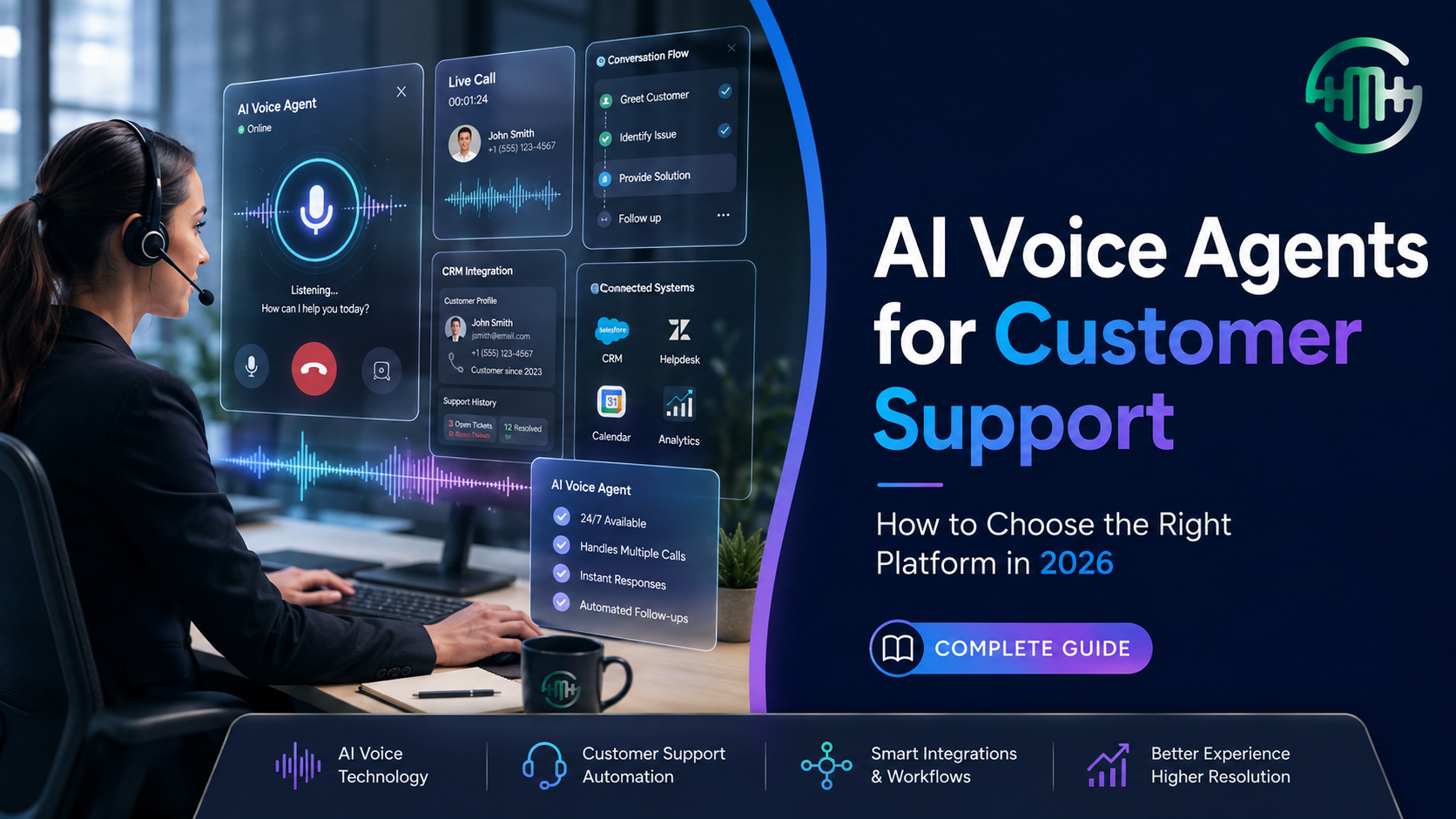
Customer support teams are facing increasing pressure to handle more conversations while maintaining fast and personalized service. Traditional phone systems and IVR solutions often struggle with complex customer requests, changing conversations, and high call volumes.
AI voice agents are helping businesses automate customer interactions, manage repetitive queries, and improve support operations through real-time voice conversations.
However, selecting the right AI voice platform is not only about voice quality. Businesses need to evaluate conversation handling, integrations, scalability, security, and how well the solution fits their support workflow.
This guide explains the important factors to consider when choosing an AI voice agent for customer support.
Looking for a basic understanding of AI voice agents? Read our complete AI voice agent guide.
What Is an AI Voice Agent for Customer Support?
An AI voice agent is an artificial intelligence system that handles customer phone conversations using voice recognition, natural language processing, and automated workflows. It can answer customer queries, complete support tasks, connect with business systems, and transfer complex issues to human agents when required.
What Makes an AI Voice Agent Suitable for Customer Support?
Not every voice AI platform is built for customer service. Support environments require AI systems that can understand customer intent, maintain conversation context, and complete real business tasks.
Natural Voice Conversations
A customer support AI agent should handle real conversations instead of following rigid scripts.
Important capabilities:
- Natural responses
- Context retention
- Interruption handling
- Smooth conversation flow
Accurate Intent Recognition
Customer queries are often unclear or incomplete. AI voice agents should understand the actual purpose behind customer requests.
Examples:
- Order tracking
- Appointment changes
- Account questions
- Technical support requests
Human Agent Handoff
AI should support human teams, not create barriers.
A reliable platform should transfer complex conversations with:
- Customer details
- Conversation history
- Issue summary
- Correct routing
Business Integrations
AI voice agents become more effective when connected with:
- CRM platforms
- Helpdesk software
- Ticketing systems
- Knowledge bases
- Business applications
AI Voice Agent vs Traditional IVR
| Feature | Traditional IVR | AI Voice Agent |
|---|---|---|
| Conversation | Fixed menu options | Natural conversations |
| Understanding | Limited commands | Intent-based understanding |
| Flexibility | Predefined flows | Dynamic responses |
| Personalization | Limited | Customer data integration |
| Task Completion | Basic routing | Automated support actions |
| Customer Experience | Menu navigation | Conversational interaction |
Traditional IVR works well for simple call routing, while AI voice agents are designed for more flexible customer conversations.
How We Evaluate AI Voice Agent Platforms
Choosing an AI voice platform requires evaluating more than marketing features.
We consider:
Conversation Quality
- Natural speech
- Context handling
- Follow-up questions
- Error recovery
Customer Support Capabilities
- Query resolution
- Workflow automation
- Human escalation
- Support scenarios
Integration Options
- CRM compatibility
- Helpdesk connections
- API availability
Performance
- Response speed
- Call stability
- Scalability
Pricing & Business Fit
- Pricing model
- Implementation requirements
- Long-term value
Key Features To Look For In an AI Voice Agent
Voice Quality & Response Speed
Fast and natural conversations are important for maintaining a good customer experience.
AI Understanding
The platform should understand customer intent and handle changing conversations.
Analytics & Insights
Useful features include:
- Call summaries
- Conversation analysis
- Customer trends
- Resolution tracking
Security & Compliance
Businesses should evaluate:
- Data protection
- Access controls
- Industry requirements
AI Voice Agent Platforms Compared
1. Retell AI
Best For: Real-time customer support automation
Retell AI focuses on building conversational voice agents that can manage customer calls with real-time responses and customizable workflows.
Key Strengths:
- ✓ Natural voice conversations
- ✓ Low-latency interactions
- ✓ API integrations
- ✓ Call analytics
Considerations:
- Pricing depends on usage and configuration
2. PolyAI
Best For: Enterprise customer support teams
PolyAI focuses on large-scale conversational AI deployments for organizations handling complex customer interactions.
Key Strengths:
- ✓ Enterprise-grade conversations
- ✓ Advanced workflows
- ✓ Large-scale support handling
Considerations:
- Better suited for organizations with larger requirements
3. Cognigy
Best For: Complex enterprise automation
Cognigy provides conversational AI solutions across voice and digital channels.
Key Strengths:
- ✓ Omnichannel support
- ✓ Advanced workflow management
- ✓ Contact center integrations
Considerations:
- Requires more planning for implementation
4. CloudTalk
Best For: Businesses combining calling and AI automation
CloudTalk combines business phone systems with AI-powered calling capabilities.
Key Strengths:
- ✓ Call management
- ✓ CRM integrations
- ✓ Business workflows
Considerations:
- Best fit for businesses already using cloud calling systems
5. Synthflow AI
Best For: Quick AI voice automation
Synthflow focuses on no-code AI voice agent creation.
Key Strengths:
- ✓ Fast setup
- ✓ No-code workflows
- ✓ Simple deployment
Considerations:
- Complex enterprise workflows may require evaluation
AI Voice Agent Comparison Table
| Platform | Best For | Key Strength |
|---|---|---|
| Retell AI | Customer support automation | Real-time voice conversations |
| PolyAI | Enterprise teams | Complex support workflows |
| Cognigy | Large organizations | Advanced automation |
| CloudTalk | Business calling | Calling workflows |
| Synthflow AI | Quick deployment | No-code automation |
Best AI Voice Agent Based on Business Type
SaaS Companies
Focus on:
- Product support
- Customer onboarding
- Knowledge base integration
Ecommerce Businesses
Useful for:
- Order updates
- Returns
- Delivery queries
- Customer assistance
Healthcare Organizations
Important capabilities:
- Appointment scheduling
- Patient communication
- Secure information handling
Small Businesses
Prioritize:
- Easy setup
- Affordable pricing
- Simple automation
Enterprise Teams
Look for:
- Scalability
- Security controls
- Advanced integrations
AI Voice Agent Pricing: What Businesses Should Know
AI voice agent cost depends on:
- Call volume
- Platform features
- Integrations
- Custom workflows
Common pricing models include:
Usage-Based Pricing
Charges are based on usage, such as call duration or conversations.
Subscription Pricing
Monthly plans based on features and limits.
Enterprise Pricing
Custom pricing for businesses requiring advanced support, security, and scalability.
How To Choose The Right AI Voice Agent?
Before selecting a platform, evaluate:
- ✓ Customer support goals
- ✓ Type of calls to automate
- ✓ Required integrations
- ✓ Security needs
- ✓ Scalability requirements
- ✓ Human escalation process
The right AI voice agent should solve real support challenges rather than simply provide automation.
Common Mistakes When Choosing an AI Voice Agent
Selecting Only Based on Voice Quality
A realistic voice is useful, but conversation intelligence and workflow support are equally important.
Ignoring Integrations
Without CRM and support system connections, automation value can be limited.
Not Testing Real Scenarios
Businesses should test:
- Complex queries
- Interruptions
- Different customer situations
- Human handoffs
Choosing Only The Cheapest Platform
Cost matters, but reliability and business fit are more important for customer-facing systems.
AI Voice Agent Implementation Checklist
Before deployment:
- ✓ Define automation goals
- ✓ Identify common customer queries
- ✓ Prepare knowledge base
- ✓ Connect business systems
- ✓ Create escalation rules
- ✓ Test conversations
- ✓ Monitor performance
Frequently Asked Questions
Can AI voice agents replace customer support teams?
AI voice agents help support teams by handling repetitive tasks while human agents focus on complex customer issues.
How much does an AI voice agent cost?
Pricing depends on usage, platform features, integrations, and customization requirements.
Can AI voice agents connect with CRM systems?
Yes, many AI voice platforms support CRM, helpdesk, and business system integrations.
Are AI voice agents suitable for small businesses?
Yes, small businesses can use AI voice agents for automating repetitive customer interactions and improving response times.
Which industries use AI voice agents?
Common industries include SaaS, ecommerce, healthcare, finance, real estate, and customer service operations.
Conclusion
AI voice agents are becoming an important part of modern customer support by helping businesses manage conversations, automate repetitive requests, and improve response efficiency.
The best platform depends on your business goals, support workflow, integrations, and scalability requirements.
Before choosing an AI voice solution, focus on conversation quality, reliability, security, and long-term business value.