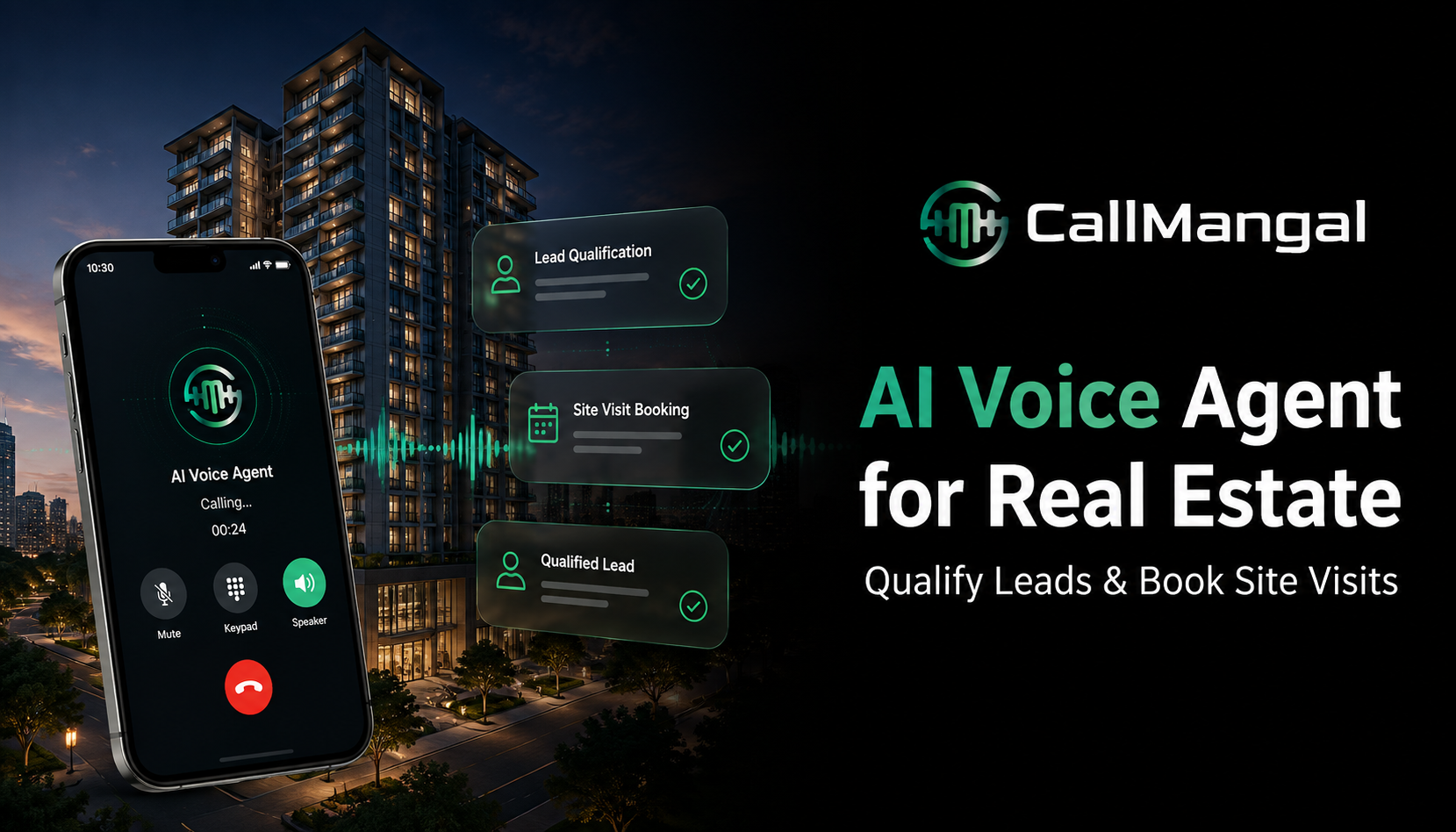
An AI voice agent for real estate can contact new property enquiries, collect details such as location, configuration, budget, and buying timeline, book site visits, update sales systems, and hand serious prospects to a salesperson.
For Indian real estate teams, that makes voice AI particularly useful in the space between a new enquiry arriving and a salesperson beginning a serious sales conversation.
Consider a buyer who submits an enquiry for a 3BHK at 9:40 PM.
They are looking in Gurgaon, have a budget of around ₹1.4 crore, and hope to buy within the next few months.
The useful next step is not another automated marketing message. It is a conversation that establishes what the buyer actually wants and whether there is a sensible next action.
That is the job this workflow is designed to handle.
Where does an AI voice agent fit in a real estate sales process?
A real estate AI voice agent can make or answer phone calls and complete defined tasks during the conversation.
For example, it can ask about a buyer's requirements, use approved project information, capture qualification data, offer an available site-visit slot, and record the outcome in the CRM.
It is not the same as an IVR that asks callers to press buttons, and it does not need to take over every sales conversation.
CallMangal's broader guide to AI voice agents explains the underlying technology, IVR differences, and general voice-AI architecture in more detail.
For a property sales team, the more useful question is:
What should happen after a new lead answers the phone?
How does a property enquiry become a qualified lead?
A good workflow gradually turns an enquiry into information the sales team can act on.
Property enquiry → conversation → buyer requirements → qualification → next actionThe first conversation might establish:
| Signal | Example |
|---|---|
| Location | Gurgaon |
| Configuration | 3BHK |
| Budget | ₹1.3–1.5 crore |
| Purpose | Self-use |
| Purchase timeline | Within 3 months |
| Financing | Home loan likely |
| Project stage | Already comparing options |
| Site-visit intent | Interested this weekend |
The value is not simply that the call happened.
The value is that the sales team now knows what kind of buyer it is dealing with.
A useful CRM note might look like:
3BHK · Gurgaon · ₹1.3–1.5Cr · self-use · 3-month timeline · home loan likely · Saturday site visit requested
Compare that with:
Interested lead. Call back.
The first record tells the salesperson where to continue the conversation. The second forces them to qualify the buyer again.
Should every lead be classified as hot, warm or cold?
Lead scoring can help with prioritisation, but it should not pretend to predict who will eventually buy.
A hot lead may have a clear requirement, workable budget, near-term buying timeline and willingness to visit the project.
A warm lead may have genuine interest but still be uncertain about timing, budget or project choice.
A cold or early-stage lead may simply be researching the market.
Those labels should determine the next sales action, not permanently define the buyer.
Someone exploring today may become a serious prospect later.
What should an AI voice agent ask a property buyer?
The shortest useful qualification flow is usually better than a long checklist.
Questions should be chosen because the answers change what happens next.
For example:
| Question | What it tells the team |
|---|---|
| Which location are you considering? | Project fit |
| Are you looking for a 2BHK, 3BHK, villa, or plot? | Inventory relevance |
| What budget range are you considering? | Commercial fit |
| Is this for self-use or investment? | Buyer context |
| When are you planning to purchase? | Urgency |
| Would you require a home loan? | Financing context |
| Have you shortlisted any projects? | Buying stage |
| Would you like to visit the property? | Immediate next-step intent |
If some of this information is already available from the enquiry form or CRM, the caller should not be forced to repeat it unnecessarily.
The qualification flow should fill information gaps rather than behave like a fixed questionnaire.
That makes the conversation shorter and gives the salesperson cleaner data.
What can a Hindi-Hinglish property call sound like?
Real property conversations in India often switch naturally between Hindi and English.
A short qualification call might sound like this:
Agent: Aap 2BHK dekh rahe hain ya 3BHK?
Buyer: 3BHK. Gurgaon side mein chahiye.
Agent: Approximate budget range kya rahega?
Buyer: Around 1.4 crore. Project ke hisaab se thoda flexible hai.
Agent: Property self-use ke liye hai ya investment?
Buyer: Self-use.
Agent: Aur roughly kab tak purchase plan kar rahe hain?
Buyer: Next three-four months.
Agent: Would you like to visit the project this week?
Buyer: Saturday possible hai?
The resulting sales record could contain:
Configuration: 3BHK
Location: Gurgaon
Budget: Approx. ₹1.4 crore
Purpose: Self-use
Timeline: 3–4 months
Visit preference: Saturday
This is a better multilingual test than asking whether a platform technically lists "Hindi" as a supported language.
The conversation needs to survive normal code-switching, locations, numbers, real estate terminology, and follow-up questions. CallMangal has a separate guide covering Hindi/Hinglish and multilingual voice-AI testing in more depth.
How can an AI voice agent book a site visit?
Once a qualified buyer says they want to visit, the workflow changes from qualification to coordination.
The system can check the relevant booking or business calendar, offer available slots, and confirm a suitable time.
After confirmation, the workflow may trigger:
Calendar booking → CRM update → buyer confirmation → sales-representative notificationA WhatsApp message can carry approved practical information such as the appointment time, location, map link, or salesperson contact details.
CallMangal currently supports connections with CRM platforms, WhatsApp, Google Calendar, Cal.com, webhooks and REST APIs, alongside human call transfers.
The workflow should also deal with what happens after the booking.
If a buyer changes their mind on Friday evening, an outdated Saturday appointment should not remain marked as a successful conversion.
For that reason, teams should separately measure:
site visits booked and site visits attended.
The difference between those numbers can reveal problems that the initial call alone cannot solve.
When should the AI stop and transfer the buyer to a person?
A voice agent should have clear knowledge and authority boundaries.
Consider this question:
"If I book today, what is the lowest final price you can give me?"
Unless the system has explicit authority to negotiate that offer, the correct response is not to invent one.
Human escalation is usually appropriate when the buyer:
- wants to negotiate pricing or terms;
- asks for project information that cannot be verified;
- needs detailed financing or legal guidance;
- raises an unusual exception;
- is highly interested and ready for a serious sales discussion; or
- simply asks to speak with a person.
Property inventory, prices, availability, possession information, and offers can change. A voice agent should therefore work from approved information and escalate when a reliable answer is unavailable.
A useful real estate agent is not the one that can keep talking the longest. It is the one that knows when the conversation should move to sales.
What should a real estate team measure after launch?
Do not judge a real estate voice agent mainly by how human the voice sounds.
Measure whether the sales process improved.
A practical scorecard can include:
| Metric | What it reveals |
|---|---|
| Contact rate | How many intended leads actually enter a conversation |
| Qualification completion rate | How often required buyer information is collected |
| Qualified-lead rate | How many conversations meet your sales criteria |
| Site-visit booking rate | How many suitable prospects book |
| Site-visit show rate | How many booked buyers actually attend |
| Human-transfer rate | How often and why salespeople are needed |
| CRM/action success rate | Whether promised follow-up actions actually happen |
| Cost per qualified lead | Operational economics of the workflow |
Start with your current funnel.
For example:
1,000 enquiries → contacted → qualified → visit booked → visit attended → sales opportunityThen compare the same funnel after automation.
Do not begin with an assumed claim such as "AI increases conversions by 40%."
If contact rate improves but site-visit bookings do not, qualification or script quality may need work.
If bookings increase but attendance does not, reminders, buyer quality or site-visit coordination may be the real bottleneck.
That gives the business something more useful than a vanity metric.
Is AI calling for real estate compliant in India?
There is no single "AI voice agent compliance" checkbox.
A real-estate deployment touches several different areas.
Property information
RERA makes promoters responsible for the veracity of information contained in advertisements and prospectuses.
An AI conversation is not automatically the same legal category as every advertisement or prospectus, but the operational lesson is important: project facts communicated to buyers should come from controlled, current sources.
The agent should not improvise pricing, carpet area, possession dates, inventory, amenities or offers.
Commercial calls
India's TCCCPR framework regulates commercial communication and is intended to protect subscribers from unsolicited commercial communication while allowing communications consistent with customer preferences.
TRAI also released a March 2026 draft Third Amendment proposing an explicit definition for Application-to-Person calls that includes certain software-initiated and artificial-voice calling. Responses to that consultation were still appearing in TRAI's published material, so the proposal should not be presented as final law without checking its current status immediately before deployment.
Personal data
A qualification call may involve names, phone numbers, budgets, location preferences, financing information, recordings and transcripts.
India's DPDP Act and 2025 Rules have phased commencement dates, so businesses should check which requirements are in force at the time of deployment rather than relying on a generic "DPDP compliant" label.
In practice, the deployment should document what information is collected, why it is needed, who can access it, where recordings and transcripts go, and how long they are retained.
For regulated or high-risk deployments, legal and compliance teams should review the actual workflow.
Is voice AI already being used in Indian real estate?
Yes, although one company's results should never be treated as an industry-wide guarantee.
A June 2026 customer story published by ElevenLabs describes how Indian real estate services company Anarock built its Genie AI calling platform for workflows including fresh-lead qualification, cold-lead re-engagement, overflow calls and channel-partner qualification. The qualification process uses factors such as budget, configuration, and locality before trying to move suitable buyers toward a site visit.
ElevenLabs reports that the deployment handled 8.5 million successful interactions in the previous financial year versus 1.7 million completed by the human sales team, and that around 30% of customer conversations took place outside business hours. Those figures are Anarock results reported in an ElevenLabs customer story, not CallMangal benchmarks or guaranteed outcomes for another real estate business.
The useful takeaway is the operating model:
High-volume qualification can happen before the high-value human sales conversation.
How can CallMangal handle this workflow?
CallMangal already positions its real estate workflow around property lead qualification, buyer-requirement capture, site-visit scheduling, post-visit follow-up, and transferring serious prospects to sales.
A focused first deployment could look like:
New enquiry → qualification call → buyer requirements captured → suitable prospect identified → site visit offered → CRM/calendar updated → salesperson receives contextCallMangal also provides recordings and transcripts, Hindi-English mixed-language calling, CRM and WhatsApp actions, calendar integrations, and live human handoff.
There is no need to automate the entire real estate sales operation on day one.
Start with one repeatable workflow where success is easy to measure.
For many teams, new property enquiry → qualification → site visit or sales handoff is enough to find out whether voice AI is actually improving the funnel.
The practical role of AI in a property sale
A buyer choosing a home still needs people.
Negotiation, trust, project understanding, and high-value decision-making are not the parts a real estate team should rush to remove.
The more practical opportunity is earlier in the funnel: making sure new enquiries are understood, qualified, and moved to the right next action, while the sales team gets useful context instead of another unworked lead.
Want to test that workflow with a real property enquiry? Try a CallMangal lead-qualification call or book a live demo with your real estate use case.
.webp)