A patient calls a hospital to book an appointment with a cardiologist. The receptionist is already speaking to another patient, two people are waiting at the front desk, and another call starts ringing.
The patient waits for a few moments before disconnecting. They may try again later, or they may contact another hospital.
This is an everyday challenge for busy healthcare facilities. Hospital reception teams are responsible for answering calls, scheduling consultations, checking doctor availability, handling cancellations, and helping patients who arrive in person.
When several requests come in together, even an experienced team can struggle to respond quickly.
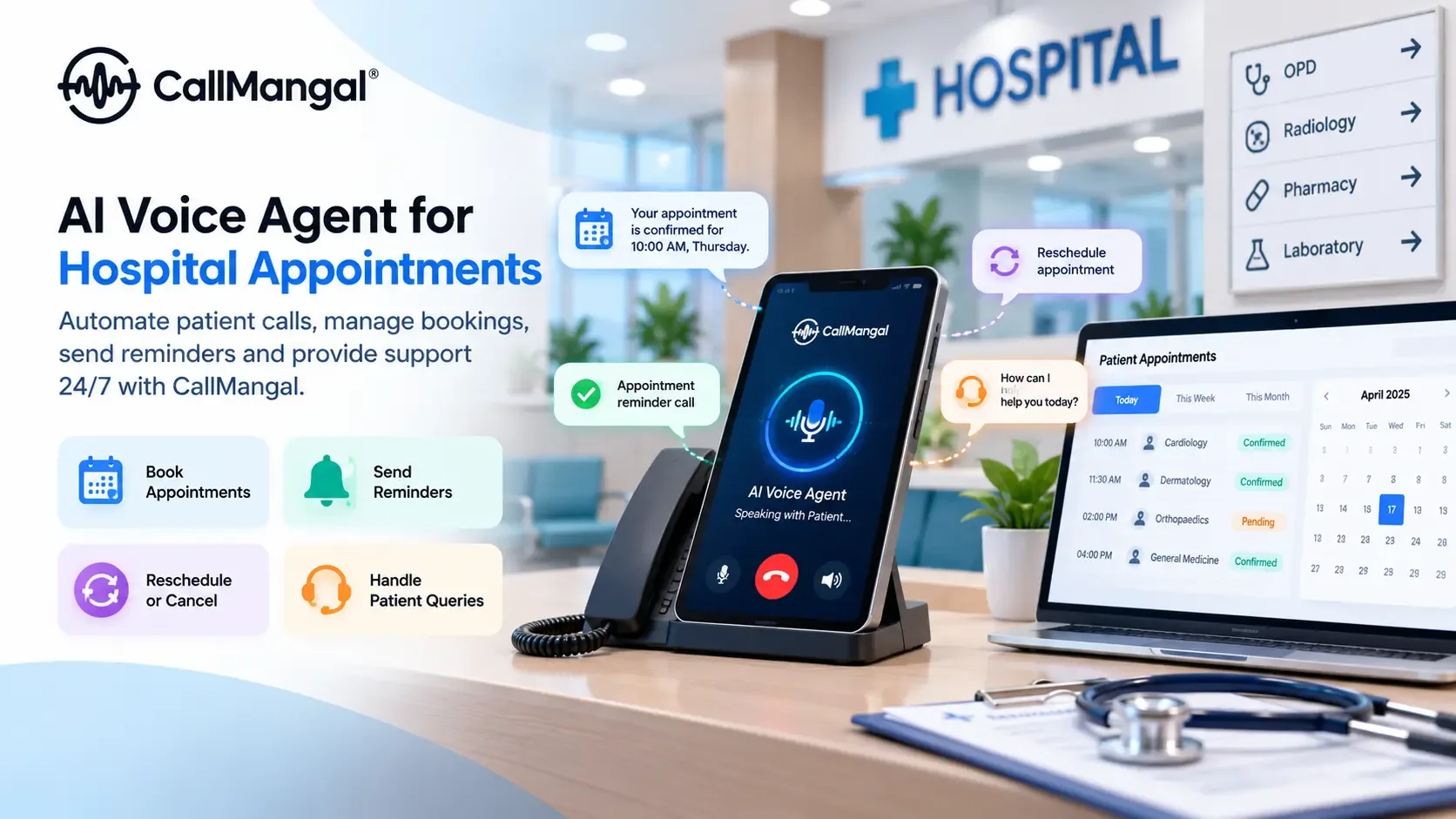
AI voice agents for hospitals offer a practical way to manage some of this workload. They can answer routine appointment enquiries, collect booking details, assist with scheduling, and help patients reach the right department without requiring a receptionist to handle every conversation.
The goal is not to remove people from patient care. It is to make routine communication easier for patients and hospital staff.
Why Patient Appointment Management Is Challenging for Hospitals
Managing appointments involves more than adding a patient's name to a calendar.
A receptionist may need to confirm the doctor's schedule, identify the correct department, check available consultation slots, explain appointment requirements, and update the hospital's booking records.
These tasks become more difficult when calls arrive during busy periods.
Missed Calls During Peak Hours
Hospitals often receive multiple appointment enquiries around the same time, particularly in the morning when patients are trying to arrange consultations.
A receptionist who is helping someone at the counter cannot always answer an incoming call immediately.
For patients, repeated unanswered calls can make a simple booking unnecessarily frustrating.
Frequent Rescheduling Requests
Patients sometimes need to change appointments because of work commitments, travel difficulties, or personal circumstances.
Similarly, doctors may have schedule changes that require hospital staff to contact affected patients.
Handling these changes manually takes time, especially when staff must update several records and notify different people.
Repetitive Appointment Questions
Many callers ask similar questions:
- Is the dermatologist available tomorrow?
- Can I book an appointment for Saturday?
- What time does the outpatient department open?
- How do I change my appointment?
- Where should I report for my consultation?
Although these questions are straightforward, answering them repeatedly occupies time that reception staff could spend helping patients with more complicated needs.
This is where hospital appointment automation can make a meaningful difference.
What Is an AI Voice Agent for Healthcare?
An AI voice agent is a software-based calling assistant that can communicate with people through spoken conversations.
Unlike a traditional recorded phone menu that asks callers to press different numbers, a conversational AI agent can listen to a request and respond using information and workflows configured by the organisation.
For example, a patient might say:
"I need to book an appointment with a skin specialist for Friday."
A properly configured voice agent can identify that the caller wants a dermatology appointment, ask for the necessary details, and check available slots if it is connected to the hospital's scheduling system.
The conversation may continue with the patient selecting a suitable time and confirming the booking.
If the agent cannot complete the request, it should offer an appropriate transfer or callback option.
An important distinction is that an AI voice agent for healthcare handles administrative communication. It should not independently diagnose symptoms, recommend treatments, or decide whether a patient needs urgent medical attention.
Those responsibilities belong to qualified healthcare professionals.
7 Ways Hospitals Can Use AI Voice Agents for Patient Appointments
1. Answer Appointment Enquiries Without Long Waiting Times
Consider a multi-specialty hospital receiving calls for cardiology, orthopedics, dermatology, and general medicine.
Each caller may need information about a different doctor or department.
An AI-powered hospital receptionist can begin by asking which department or specialist the patient wants to contact.
It can then provide approved information about consultation hours, booking procedures, and available services.
This helps patients get answers to routine questions without waiting for the front-desk team.
Where the system supports concurrent conversations, multiple callers can receive assistance during busy periods.
2. Help Patients Book Doctor Appointments
Appointment booking is one of the most practical applications of AI calling agents for hospitals.
Imagine a patient calling a clinic in Jaipur to schedule an appointment with an orthopedic specialist.
The conversation could follow a simple process:
- The agent asks which specialist the patient wants to visit.
- It collects the patient's name and necessary contact information.
- It checks available appointments through the connected scheduling system.
- The patient selects a convenient slot.
- The booking is confirmed and recorded.
This process requires reliable access to current appointment availability.
Without a scheduling integration, the agent may collect the request for staff to process later, but it should not promise that a particular appointment has been booked.
That distinction matters. A patient arriving for an appointment that was never recorded creates more work for everyone involved.
3. Send Automated Patient Appointment Reminders
Patients sometimes forget appointments, confuse dates, or realize too late that they cannot attend.
An automated reminder workflow can help hospitals communicate appointment details before the scheduled visit.
For example, a patient with a consultation booked for Thursday could receive an approved reminder call on Wednesday.
The voice agent might confirm the appointment date and time and ask whether the patient still plans to attend.
If the patient wants to reschedule, the system can direct them to the appropriate booking process.
Automated patient appointment reminders may help hospitals identify cancellations earlier and reduce some avoidable administrative follow-ups.
However, reminders cannot guarantee attendance, and their effectiveness depends on patient preferences, timing, and the way the workflow is configured.
Hospitals should also avoid including unnecessary sensitive medical information in automated messages.
4. Manage Appointment Rescheduling and Cancellations
Changing an appointment should not require a patient to explain the same request several times.
Suppose a patient has a consultation booked for Monday but needs to move it to Wednesday.
An AI voice agent connected to the appointment system could verify the necessary booking details, check alternative availability, and help complete the change.
The original appointment can then be released according to hospital policy.
If the requested time is unavailable, the agent can explain the available alternatives or arrange a callback from the reception team.
This can be especially useful for hospitals that receive frequent scheduling changes across multiple departments.
The workflow must also prevent duplicate bookings and ensure that any change is accurately reflected in the hospital's records.
5. Handle Appointment Calls Outside Reception Hours
Patients do not always remember to contact hospitals during working hours.
Someone may finish work late in the evening and decide to arrange a consultation for the following week.
If the reception desk is closed, that person may have to wait until the next morning.
An AI voice agent can provide an after-hours communication channel for routine appointment requests.
Depending on the hospital's system, it could collect booking information, provide approved consultation details, or complete appointments where live scheduling is available.
For requests that require staff approval, the agent can record the information and explain when the patient should expect a response.
This does not mean the agent should function as an emergency medical helpline.
Hospitals must provide clear instructions for urgent medical situations and ensure callers are directed to appropriate emergency services.
6. Support Patients in Different Languages
Language can affect how comfortably a patient communicates with hospital staff.
In India, callers may prefer Hindi, English, or another regional language. Some may naturally switch between languages during a conversation.
For example, a patient might ask:
"Kal morning mein physician ka appointment mil sakta hai?"
A multilingual AI voice agent that has been properly tested for this type of conversation may be able to understand the request and continue in the caller's preferred language.
This can make routine appointment communication more accessible.
However, language support should be evaluated carefully.
Hospitals should test real doctor names, department names, regional accents, background noise, and mixed-language conversations before introducing the system to patients.
A feature listed on a product website is not a substitute for practical testing.
7. Transfer Complex Requests to Hospital Staff
Not every hospital call should be handled through automation.
Some patients have complicated appointment requirements. Others may be upset, confused, or concerned about a medical situation.
An effective system must recognize when a human should take over.
For example, a caller may need assistance coordinating appointments across several departments. Another patient may have a billing dispute or require special accessibility arrangements.
Rather than continuing with an unsuitable scripted response, the agent should transfer the conversation to an appropriate staff member or arrange a callback.
Where technically supported and permitted, the handover should include the relevant information already collected so the patient does not have to repeat everything.
Good hospital call automation supports reception staff rather than trying to replace their judgement.
How AI Appointment Scheduling Can Help Hospital Operations
The potential benefits extend beyond answering calls.
More Time for Patients at the Front Desk
When routine enquiries are handled through automation, receptionists can concentrate on patients who need direct assistance.
This includes elderly visitors, people who require help with hospital procedures, and patients with complicated administrative requests.
More Consistent Appointment Information
An AI voice agent connected to an accurate, maintained information source can provide consistent answers about consultation timings and booking procedures.
This is particularly helpful when hospitals operate several departments with different schedules.
However, outdated information can be repeated just as consistently as correct information. Hospitals must therefore assign responsibility for keeping the system updated.
Better Visibility Into Appointment Enquiries
Call logs and structured outcomes can help hospital administrators understand why patients are contacting the reception desk.
For example, a hospital might discover that many callers ask about appointment availability on weekends.
That information can help the team improve website information, staffing arrangements, or scheduling processes.
Hospitals should collect only the information they need and manage call records according to applicable privacy requirements.
Less Repetitive Administrative Work
Hospital staff often spend time answering the same questions or contacting patients for routine confirmations.
Automating suitable workflows may reduce some of this repetitive work.
The actual benefit depends on call volume, integration quality, patient acceptance, and how often calls still require human assistance.
Hospitals should measure results rather than assume that automation will automatically reduce costs.
What Hospitals Should Consider Before Implementing AI Voice Agents
Introducing an AI calling system requires more planning than simply connecting a phone number.
Integration With Existing Appointment Systems
A hospital may already use a hospital management system, appointment scheduling platform, or electronic health record system.
The AI agent needs access to the appropriate information to check appointment availability and update bookings.
Hospital administrators should ask vendors whether an existing integration is available or whether custom development is required.
They should also confirm how booking conflicts, cancelled appointments, and system outages are handled.
Patient Data Privacy and Security
Appointment calls may involve names, phone numbers, doctor preferences, and other personal information.
Hospitals should establish clear rules for collecting, processing, storing, and deleting this information.
Important considerations include patient notices, consent where required, access controls, recording policies, vendor responsibilities, and applicable Indian data protection requirements.
Healthcare organizations should review these obligations with their legal and compliance teams before deployment.
Accurate Information and Clear Limitations
The agent should answer only from approved hospital information and reliable connected systems.
It should not invent appointment availability, consultation charges, doctor schedules, or hospital policies.
When information is unavailable, the correct response is to explain the limitation and direct the caller to staff.
Emergency Escalation
A caller describing a potentially urgent medical problem should not be treated as a routine appointment enquiry.
Hospitals need a defined process for directing urgent callers to appropriate medical or emergency services.
AI voice agents should never be presented as a substitute for emergency assessment or professional medical judgement.
Testing Before Launch
Before introducing the system to patients, hospitals should test different situations.
These include straightforward bookings, unavailable doctors, cancelled slots, unclear speech, language switching, duplicate requests, and calls that require human support.
Testing should also cover what happens when the appointment database or network connection is unavailable.
A controlled pilot with a limited workflow is generally more manageable than automating every hospital call immediately.
How CallMangal Can Support Hospital Appointment Workflows
Hospitals considering AI-based calling can evaluate platforms such as CallMangal for managing routine voice conversations.
CallMangal offers AI voice agent capabilities for business communication, including inbound and outbound calling, configurable conversation workflows, and options for connecting with external systems.
For a hospital, these capabilities could support appointment-related workflows such as responding to booking enquiries, collecting scheduling requests, making configured reminder calls, and routing selected conversations to staff.
The exact workflow depends on the hospital's requirements and the integrations available.
For example, an appointment-booking agent would need access to current doctor availability before confirming a consultation. If a native connection to the hospital's management system is unavailable, additional API or webhook integration work may be required.
Hospital administrators should also confirm how CallMangal handles language preferences, human handovers, recordings, data access, and privacy requirements.
A practical starting point is to test one administrative use case, such as appointment enquiries or reminders, before expanding into more complicated scheduling tasks.
The objective is to build a dependable communication process that works alongside the hospital's existing team.
A Practical Starting Point for Hospitals
A hospital does not need to automate its entire reception department at once.
A smaller implementation can provide a clearer picture of what works.
For example, a hospital could begin with routine appointment enquiries for one outpatient department.
The team can document common questions, provide accurate scheduling information, and define when calls must be transferred to a receptionist.
During the pilot, administrators can review whether callers receive correct answers, whether appointment requests are recorded accurately, and whether patients can reach a person when needed.
Feedback from reception staff is equally important.
They are often the first to notice missing information, confusing conversations, and situations that do not fit a standard workflow.
Once the process is reliable, the hospital can consider adding appointment reminders, rescheduling assistance, or additional departments.
Conclusion
Managing patient appointments is a daily responsibility that affects both hospital operations and the patient experience.
Missed calls, repetitive enquiries, scheduling changes, and after-hours requests can place considerable pressure on reception teams.
AI voice agents provide a way to handle selected administrative conversations more consistently, provided they are connected to accurate information and supported by clear human escalation processes.
For hospitals, the most useful approach is not to automate every conversation. It is to identify routine tasks that can be handled safely and reliably while allowing healthcare staff to focus on patients who need personal assistance.
Interested in exploring AI voice agents for hospital appointment management?
Visit CallMangal to explore its voice automation capabilities and discuss how an appointment-related workflow could be configured for your hospital.
Frequently Asked Questions
1. Can AI voice agents book hospital appointments automatically?
Yes, an AI voice agent can help patients book appointments when it has access to an appropriate scheduling system. It can collect the required details, check available slots, and confirm bookings according to configured rules. Without a live scheduling connection, it should collect requests rather than promise confirmed appointments.
2. How can AI voice agents reduce missed appointment calls?
An AI voice agent can answer routine incoming enquiries when reception staff are occupied. Depending on the system's capacity and configuration, it may also handle multiple conversations at the same time. Calls requiring additional assistance should be transferred or recorded for follow-up.
3. Can AI voice agents send appointment reminders to patients?
Yes. A properly configured outbound calling workflow can remind patients about upcoming appointments and collect confirmation or rescheduling requests. Hospitals should ensure reminders follow applicable privacy and communication requirements.
4. Are AI voice agents suitable for small clinics?
They can be useful for smaller clinics that receive frequent routine calls but have limited reception staff. The decision depends on call volume, costs, scheduling requirements, and whether the technology integrates with the clinic's existing processes.
5. Can an AI voice agent speak Hindi or regional Indian languages?
Some AI voice platforms support Hindi and other Indian languages. Hospitals should verify the specific languages supported by their chosen provider and test actual patient conversations before deployment.
6. Is patient information safe when using AI voice agents?
Security depends on the platform, its configuration, data-handling practices, and the hospital's own safeguards. Hospitals should evaluate encryption, access controls, retention policies, vendor agreements, and applicable privacy obligations before processing patient information.