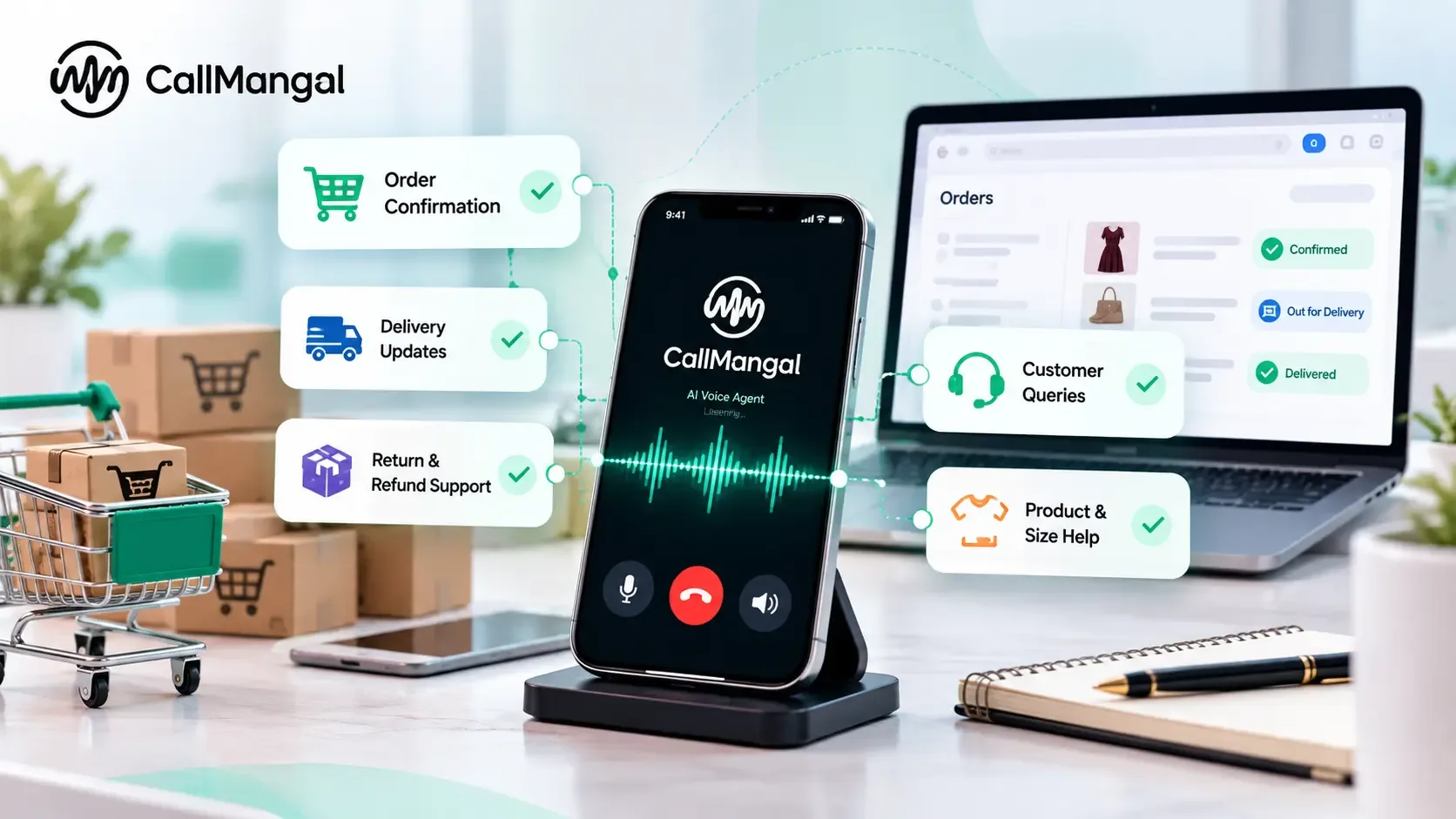
Take a hypothetical small online clothing store on a Monday morning. The weekend has left forty COD orders that nobody has confirmed. One person starts down the list with a phone in hand. Another covers the support line, which has been ringing since nine with customers asking when their parcels will arrive. The courier collects at four. Whatever has not been called by then goes out on trust.
Individually, these calls take a minute or two. Together they swallow a day, because they arrive in waves and most repeat yesterday’s calls. Software that can speak, listen and log outcomes suits this pattern. This article explains where an AI voice agent for ecommerce is useful, where it should hand over to a person, and what needs arranging before the first live call.
Why COD orders and delivery queries keep a support team busy
For many Indian sellers, the phone is part of the sales process because of cash on delivery. ClickPost, which sells logistics software, puts the cash share of Indian online orders at about 58 to 65 percent. Its figures show roughly 26 percent of COD parcels returning to the seller, against below 2 percent of prepaid ones. It also estimates a direct logistics cost of ₹150 to ₹300 for each parcel that comes back, before counting the ad that produced the order. Base.com’s 2026 benchmarks are harsher, with average COD returns at 30 to 40 percent. rto reduction tools +2
Both are vendor numbers, not audited ones, and a book seller will see something very different from a fashion seller. What they agree on is the shape of the problem: an unconfirmed COD order is a gamble with your freight money.
On the inbound side, customers ring about delivery dates, wrong pincodes, size swaps and refunds. All of it comes through one number, usually in the same busy hours.
What an AI voice agent does during a call
Think of a virtual phone executive. It answers a ring or places a call, listens, replies in spoken language and notes how the conversation ended. There is no menu to navigate. The customer talks the way they would to a shop assistant.
Stores usually use it in two ways. Inbound, it takes calls on your helpline. Outbound, an AI calling agent for ecommerce phones customers for you, for example to confirm an order. The wording, business details and limits come from you, so it works from your policies instead of improvising.
Before dispatch: confirming orders and chasing unfinished checkouts
COD verification calls
Hypothetical example. Imagine a Delhi seller of phone and watch accessories who receives a ₹6,500 smartwatch order on COD at 1 a.m. The next morning, an outbound agent calls the buyer, repeats the product, address and pincode, and asks whether someone will be home to pay. A “yes” is logged for the team. If the buyer says it was an accident, the order is marked for cancellation. If the address lacks a landmark, the agent asks for one and records it. If the conversation turns unexpected, a team member takes over.
None of this makes COD risk disappear, and no honest vendor can promise a set reduction in returns. The practical benefit is coverage: automated order confirmation calls reach every order, including the ones that arrive at midnight or in the middle of a sale.
Following up on incomplete orders
Suppose a shopper adds a kurta set, enters a phone number and leaves before paying. A short call or WhatsApp message asking whether the payment failed or the size was unclear can bring some of these buyers back. Go gently. One courteous attempt feels like help, while three feel like chasing. And since a call meant to push a sale is likely to be classed as promotional in India, consent and DND rules apply, as covered below.
After dispatch: delivery questions and festive-sale spikes
“Where is my order?”
Hypothetical example. A Bengaluru skincare label sends out a few hundred parcels a day, and a steady stream of customers ring to ask where theirs is. An inbound agent asks for the order number or the phone number used at checkout, reads the status from the tracking data it can reach, and gives the answer in Hindi or English. When the tracker says “delivered” and the customer insists nothing arrived, the agent stops and passes the case to a person with the details noted.
Everything depends on that “can reach”. An agent knows only what it is connected to. Without access to order or courier data, it can record the question but not answer it.
Festive-sale peaks
Around Diwali, a call volume that is normally fine becomes a queue. Temporary hires take time to train and are scarce at short notice. A voice agent can handle several calls at once, which suits a rush of simple questions: when will it arrive, does the offer apply, how long do I have to return it. A cautious plan is to automate one narrow call type before the sale, read the recordings, and expand only after they look good.
Language, repetitive calls and tidy follow-ups
Language is tested in practice, not on a feature list. Buyers in smaller towns often slide from Hindi to English halfway through a sentence, and a stiff formal script sounds odd to them. Before launch, try the agent with mixed speech, your actual product names and a poor line. Speech recognition makes mistakes, particularly on calls from markets or buses.
Then there is repetition. Explaining the return window for the fortieth time wastes a trained executive. Customer call automation for such fixed questions lets a small team stay small for longer, though judgement-heavy work still needs people.
Finally, give every call an ending that can be recorded: confirmed, cancelled, address changed, callback wanted, human requested. A short list of outcomes is easier to act on than a folder of audio files, and it reveals which questions your website fails to answer.
When a person should take over
Hand these to a human:
- Items that arrive damaged, wrong or not at all
- Refund disputes and failed payments
- Customers who sound upset or distressed
- Unusually large or odd orders
- Anyone who asks for a person
The handover needs as much thought as the trigger. A customer who explains a problem to an agent and then repeats it all to a human has been made worse off. Make sure caller details and the conversation so far go along with the transfer, and decide beforehand which hours your team can pick up transfers. Passing a call to an empty desk at 10 p.m. solves nothing.
What has to be in place behind the scenes
Order data. To confirm an order or read out delivery status, the agent needs order and tracking information. In practice that means a link to your store platform, whether Shopify, WooCommerce or a custom build, and sometimes to your courier. Ask any vendor how that link is built and who maintains it.
Calling rules. Indian telecom rules treat transactional, service and promotional calls differently. TRAI has directed that promotional calls in every sector go out on 140-series numbers registered with telecom providers, and customers may block them through the DND registry. A commercial call that carries promotional content is treated as promotional. An order confirmation and a “complete your purchase” nudge are therefore different things. Check with your telecom provider or legal adviser how each of your call types is classified. trainsdl
Customer data. Recordings and transcripts hold names, addresses and phone numbers. India notified its Digital Personal Data Protection Rules in November 2025, with core duties such as notice and security safeguards applying from 13 May 2027. Tell customers that calls are recorded, limit who can listen, and set a retention period. jsalaw
How CallMangal fits in
CallMangal is an AI voice agent platform built for Indian businesses. Going by its website, these are the features that matter for an online store:
- Inbound and outbound calls, plus browser-based WebRTC calls
- 32+ languages, including 12 Indian languages and mixed Hindi-English speech
- Recordings, transcripts and a structured outcome for every call
- Transfer to a configured team member, with caller details and context carried over
- A visual builder for business context, guardrails and conversation flow, with browser testing before live calls
- Links to CRMs such as HubSpot, Salesforce and Zoho CRM, to WhatsApp and calendars, and to other systems through webhooks and a REST API
Its Retail & D2C workflows cover order confirmation calls, cart-recovery follow-ups and delivery status updates, with exceptions passed to your service team. Raise one thing early: the integrations page does not list native Shopify, WooCommerce or courier-tracking connectors. Feeding order or tracking data into a call would normally go through webhooks, the API or a custom integration, so ask about scope and timelines during a demo.
Where to begin
Choose one call type with high volume and low risk, usually COD confirmation or order-status questions. Write down what the agent may say, what it must never promise and when it transfers. Test with realistic calls, including Hinglish and weak connections, and go through the recordings carefully for the first few weeks before adding a second workflow.
Handled this way, AI customer service for online stores clears the predictable calls from your team’s desk and leaves them free for customers who need a person.
Frequently asked questions
What is an AI voice agent for ecommerce?
It is a calling system for an online store. It takes or makes calls, follows spoken requests, responds in a natural voice and logs the outcome. Common uses are order confirmation, delivery questions and routine support, with staff stepping in when needed.
Can an AI calling agent confirm COD orders?
Yes. It can phone the customer, read back the product and address, and record whether the order was confirmed or cancelled. It needs access to your order details to do this well. It can cut down unconfirmed orders, but it cannot promise fewer returns.
Will it replace my support team?
No. As ecommerce customer support automation, it suits repetitive, predictable calls. Complaints, refund disputes and unusual cases still need people, and a properly configured agent transfers them instead of guessing.
Does CallMangal integrate with Shopify or WooCommerce?
The integrations page does not list native Shopify, WooCommerce or courier connectors. Webhooks, a REST API and custom integrations are available, so order data can be linked that way. Agree the scope with the CallMangal team first.
Can the agent speak Hindi?
CallMangal states support for 32+ languages, including 12 Indian languages and mixed Hindi-English speech. Try it with your own products and the phrases your customers actually use before launch.
Do I need consent to make automated calls to customers?
That depends on whether the call is transactional, service-related or promotional. Promotional calls must use 140-series numbers and respect DND and consent requirements. Confirm how your call types are classified with your telecom provider or a legal adviser.
Curious how this would sound on your own COD or delivery calls? You can try a live demo call or book a walkthrough with the CallMangal team at callmangal.com.